# How to wire a Telecaster with a bridge humbucker
Canonical page: https://guitarwiring.app/blog/how-to-wire-a-telecaster-with-a-bridge-humbucker
By Tinkercaster · 2026-11-13
A Telecaster with a humbucker in the bridge keeps the standard Tele controls: a three-way blade, one volume, one tone, and neck, both, bridge on the switch. The humbucker's hot lead goes to the bridge common on the switch, its ground and bare leads go to the volume casing, and its other two leads are soldered together and taped off.
Which lead is hot depends on the maker. On Seymour Duncan's sheet it is black, with red and white joined. On [DiMarzio's sheet](https://www.dimarzio.com/media/1536) it is red, with black and white joined. This article walks through the [Seymour Duncan harness](/wiring-diagrams/seymour-duncan/tele-humbucker-bridge-single-coil-neck) first, then [DiMarzio's](/wiring-diagrams/dimarzio/telecaster-rail-bridge-single-coil-neck-three-way), then Seymour Duncan's [push/pull coil split](/wiring-diagrams/seymour-duncan/tele-bridge-humbucker-neck-single-volume-push-pull-split). If your humbucker is in the neck instead, see [how to wire a Telecaster with a neck humbucker](/blog/how-to-wire-a-telecaster-with-a-neck-humbucker).
## The parts each sheet asks for
| Part | Seymour Duncan | DiMarzio |
| --- | --- | --- |
| Bridge humbucker | "Bridge Pickup" (not named) | [The Chopper T DP384](/catalog/dimarzio-dp384-chopper-t), rail-style, four leads and bare |
| Neck single coil | Not named; white and black leads | [Twang King Neck DP172](/catalog/dimarzio-dp172-twang-king-neck); white, black and gray leads |
| Volume | 250k | 250K custom taper (EP1200) |
| Tone | 250k | 250K custom taper (EP1200) |
| Tone capacitor | .047 cap | .022µF (EP1022) |
| Switch | 3-way blade | Three-way switch for Tele (EP1105) |
| Jack | Output jack | Switchcraft output jack, 2-conductor (EP1301) |
Seymour Duncan's sheet names no pickup models, so our drawing uses the [JB Model SH-4](/catalog/seymour-duncan-sh-4-jb) and the [Vintage Tele Rhythm STR-1](/catalog/seymour-duncan-str-1-vintage-rhythm) as examples. Our catalog parts for the rest are the [CTS 250k audio pot](/catalog/cts-250k-audio-pot), the [CRL 3-way blade](/catalog/crl-3-way-blade), the [Orange Drop .047µF](/catalog/orange-drop-047uf) and [.022µF](/catalog/orange-drop-022uf) capacitors and the [Switchcraft #11](/catalog/switchcraft-11-jack) jack.
The two sheets agree on 250k pots and differ on the tone capacitor: .047 on Seymour Duncan's, .022µF on DiMarzio's. Use the value on the sheet you follow. Our [article on pot values](/blog/250k-vs-500k-pots) covers the pot side of that choice.
## Walkthrough: Seymour Duncan, one humbucker, one single coil
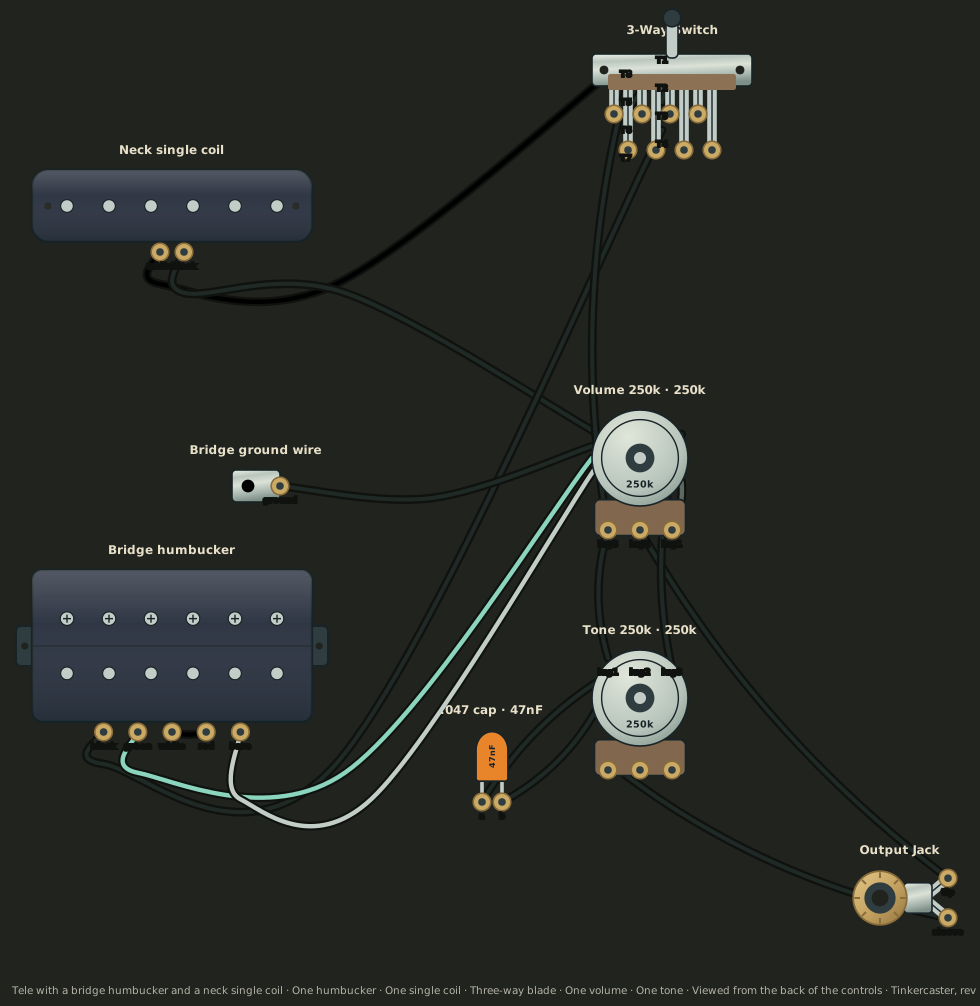
Tele with a bridge humbucker and a neck single coil, drawn by Tinkercaster from Seymour Duncan's sheet Tele_1H_1S_3B_1V_1T. Open the full diagram for every connection.
The bridge humbucker has four leads and a bare shield. On this sheet:
- **Black** goes to the switch's bottom-left lug, the bridge common.
- **Green** and **bare** go to the volume casing, on the spot the sheet's legend marks as the "location for ground (earth) connections".
- **Red and white** are joined and insulated. The sheet's note reads "Red & White wires get soldered together and taped off."
The neck single coil has two leads. White goes to the switch's top-right lug, the neck common. Black goes to the volume casing, together with the bridge ground wire.
Then the switch and controls:
| From | To |
| --- | --- |
| Switch top-left lug | Switch second left lug (jumper) |
| Switch second left lug | Switch third right lug (jumper) |
| Switch third right lug | Switch bottom-right lug (jumper) |
| Switch bottom-right lug | Volume left lug (input) |
| Volume right lug | Volume casing |
| Volume left lug | Tone left lug |
| Tone middle lug | .047 cap |
| .047 cap | Tone casing |
| Volume middle lug | Jack tip |
| Volume casing | Tone casing |
| Tone casing | Jack sleeve |
The three jumpers join four switch lugs into one output, and two lugs stay empty. The sheet doesn't number the switch positions, so our drawing maps the lugs by what they do:
| Blade | Result in the diagram |
| --- | --- |
| Neck | Neck single coil |
| Middle | Neck single coil and bridge humbucker (both coils) in parallel |
| Bridge | Bridge humbucker, both coils |
The red and white joint never moves in this harness, so the humbucker plays both coils wherever the blade selects it. The push/pull version below adds a split.
## DiMarzio: red hot, and the bridge ground on the jack
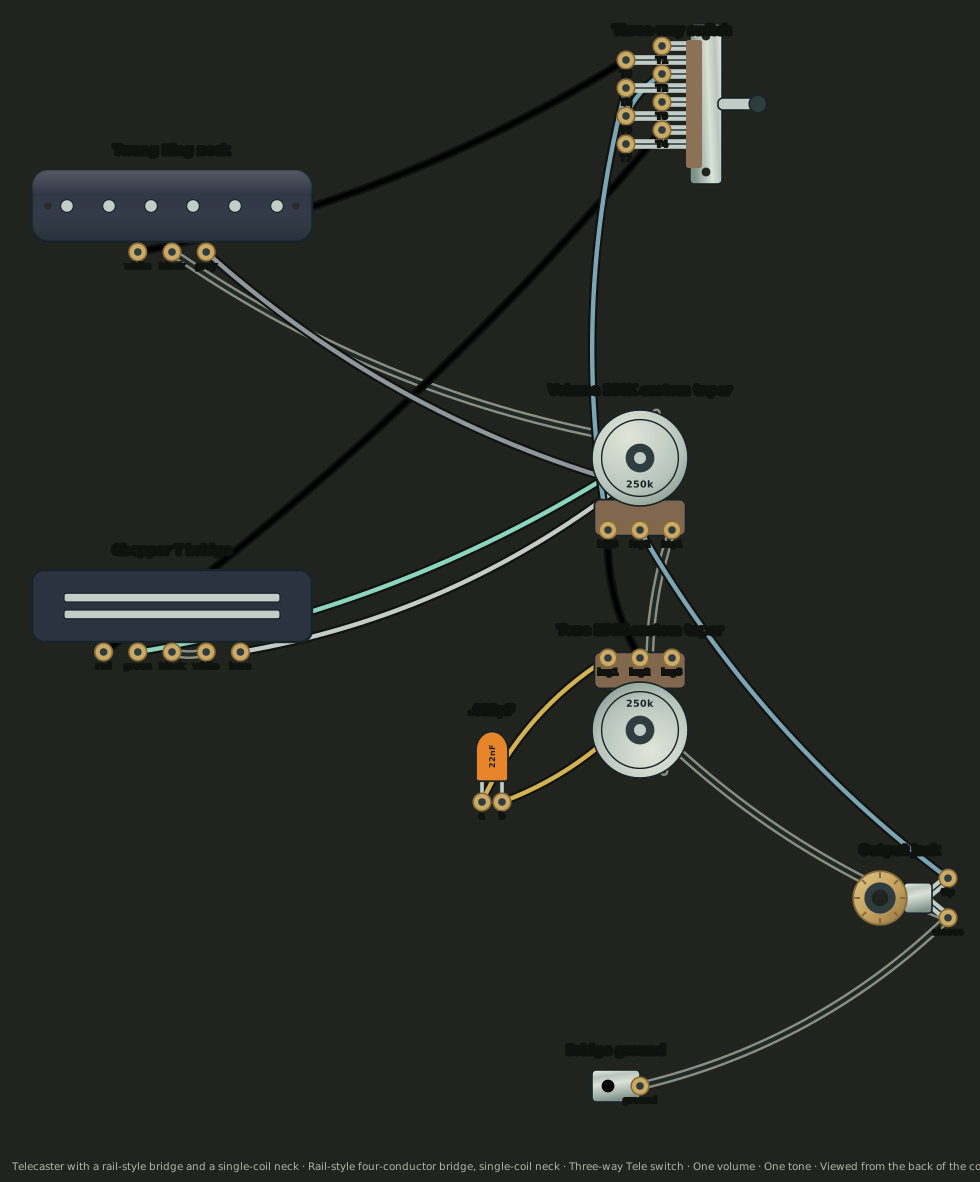
Telecaster with a rail-style bridge and a single-coil neck, drawn by Tinkercaster from DiMarzio's Rail Style Tele Bridge with Standard Neck Wiring. Open the full diagram.
[DiMarzio's sheet](https://d2emr0qhzqfj88.cloudfront.net/s3fs-public/2024-04/DiMarzio%20Rail%20Style%20Tele%20Bridge%20with%20Standard%20Neck%20Wiring.pdf) is for a rail-style Tele bridge pickup with four leads and a bare shield, the Chopper T. The sheet draws the switch on its side, so our drawing names its lugs by row:
- **Red** from the Chopper T goes to the switch's bottom row, fourth lug.
- **Green** and **bare** go to the volume casing.
- **Black and white** are joined at one solder dot and touch nothing else.
The Twang King neck has three leads. White goes to the switch's top row, first lug. Black and gray go to the volume casing.
Three more things differ from the Seymour Duncan harness:
- **The jumpers.** They run from the bottom row's first lug to its second, then to the top row's third and fourth. The top row's fourth lug feeds the volume's input.
- **The tone.** The volume's input lug goes to the tone pot's middle lug, and the capacitor sits on an end lug. On Seymour Duncan's sheet the wire lands on the tone's end lug and the cap on the middle one.
- **The ground.** The wire marked "To bridge ground" goes to the jack's sleeve, not the volume casing.
The sheet's caption reads "The three-way switch enables bridge, bridge & neck, neck." Our drawing maps it that way: the Twang King alone, the two in parallel with the Chopper T on both coils, and the Chopper T alone.
## Which lead goes to the switch
| Lead | Seymour Duncan | DiMarzio |
| --- | --- | --- |
| To the switch | Black | Red |
| Joined and taped | Red and white | Black and white |
| To ground | Green and bare | Green and bare |
Both sheets ground green and bare and join the other two leads. They differ on which of red and black is the hot. Fit the lead to the sheet from the maker of the humbucker you have. Our [pickup wire colour codes](/blog/gibson-vs-fender-pickup-wire-colour-codes) article compares the codes makers use.
## Adding a coil split with a push/pull volume
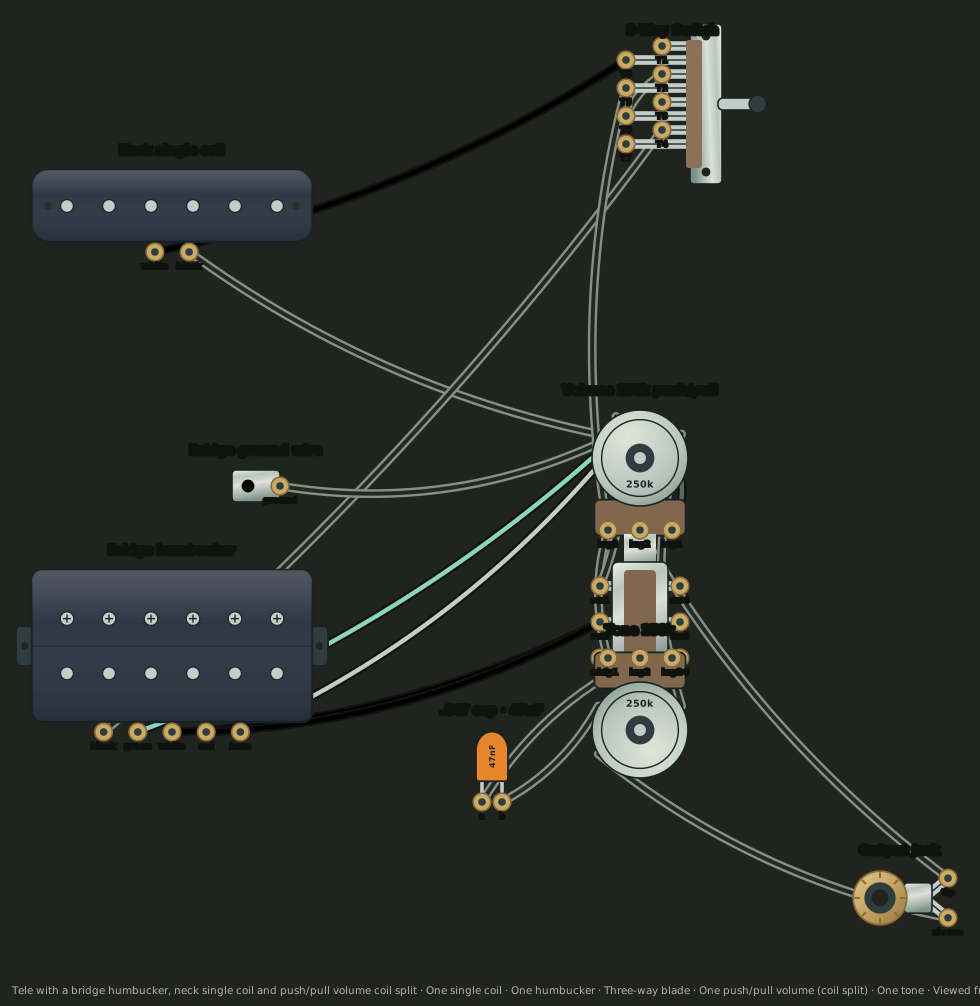
Tele with a bridge humbucker, neck single coil and push/pull volume coil split, drawn by Tinkercaster from Seymour Duncan's sheet Tele_1S_1H_3B_1VppSPL_1T. Open the full diagram.
Seymour Duncan's split version keeps everything above and changes two things. The volume becomes a 250k push/pull, and the humbucker's red and white leads are no longer taped off. They are soldered together onto the push/pull's middle-left lug. The push/pull lug nearest the pot goes to the volume casing, so pulling the knob grounds the red and white link. Only one side of the push/pull switch is used, and only two of its six lugs carry a wire.
| Blade | Knob down | Knob pulled |
| --- | --- | --- |
| Neck | Neck single coil | Neck single coil |
| Middle | Neck single coil and bridge humbucker (both coils) in parallel | Neck single coil and bridge humbucker (split to one coil) in parallel |
| Bridge | Bridge humbucker, both coils | Bridge humbucker, split to one coil |
For more ways to split a humbucker, see our [coil split wiring diagram](/blog/coil-split-wiring-diagram) guide.
## Bench checks before you plug in
These checks come from the diagrams. Set the meter to resistance and measure across the jack's tip and sleeve with the volume on full:
- In each blade setting, the meter should read the selected pickup, or the two in parallel in the middle.
- With the volume at zero, tip and sleeve should read as a short.
- On the taped harnesses, the joined pair (red and white on Seymour Duncan's, black and white on DiMarzio's) should read about one coil's resistance to ground, roughly half the pickup's total: not open, and not zero.
- On the push/pull harness, pull the knob: in the settings that select the humbucker, the reading should drop to roughly one coil.
Our [multimeter course](/courses/multimeter) covers setting up the meter.
## Next step
Open the [Seymour Duncan diagram](/wiring-diagrams/seymour-duncan/tele-humbucker-bridge-single-coil-neck), or the one for your humbucker's maker, and keep it beside the bench while you wire. For a four-way switch that adds a series setting, see [how to wire a Telecaster with a 4-way switch](/blog/how-to-wire-a-telecaster-4-way-switch). More layouts, including a [two-volume version for a Hot Rails for Tele](/wiring-diagrams/seymour-duncan/tele-bridge-humbucker-neck-single-coil-two-volumes), are in the [wiring diagram library](/wiring-diagrams).
## References
### From the Tinkercaster library
- [Tele with a bridge humbucker and a neck single coil](/wiring-diagrams/seymour-duncan/tele-humbucker-bridge-single-coil-neck) (Seymour Duncan): black hot, red and white taped, .047 cap
- [Telecaster with a rail-style bridge and a single-coil neck](/wiring-diagrams/dimarzio/telecaster-rail-bridge-single-coil-neck-three-way) (DiMarzio): red hot, tone wiper input, bridge ground on the jack
- [Tele with a bridge humbucker, neck single coil and push/pull volume coil split](/wiring-diagrams/seymour-duncan/tele-bridge-humbucker-neck-single-volume-push-pull-split) (Seymour Duncan): red and white on the push/pull
- [Tele with a bridge Tele humbucker, neck single coil and two volumes](/wiring-diagrams/seymour-duncan/tele-bridge-humbucker-neck-single-coil-two-volumes) (Seymour Duncan)
### Manufacturer sources
- Seymour Duncan, sheet Tele_1H_1S_3B_1V_1T, "Tele | 1 Humbucker | 1 Single Coil | 1 Volume | 1 Tone | 3 Way Blade": 250k volume and tone, .047 cap, "Red & White wires get soldered together and taped off"
- Seymour Duncan, sheet Tele_1S_1H_3B_1VppSPL_1T, "Tele | 1 Single | 1 Humbucker | 1 Volume push/pull Coil Split | 1 Tone | 3 Way Blade": 250k push/pull volume, red and white to the push/pull
- [DiMarzio, Rail Style Tele Bridge with Standard Neck Wiring](https://www.dimarzio.com/media/1536) and [the same sheet as a PDF](https://d2emr0qhzqfj88.cloudfront.net/s3fs-public/2024-04/DiMarzio%20Rail%20Style%20Tele%20Bridge%20with%20Standard%20Neck%20Wiring.pdf): 250K custom taper pots, .022µF, EP1105 switch, Chopper T DP384 and Twang King Neck DP172 leads