# Seymour Duncan Everything Axe wiring diagram
Canonical page: https://guitarwiring.app/blog/how-to-wire-seymour-duncan-everything-axe
By Tinkercaster · 2026-10-20
The Everything Axe set is three humbuckers in Strat single-coil size, and Seymour Duncan's sheets wire them almost like a standard Strat. The one difference is the middle pickup: its coils run in parallel, while the neck and bridge run in series. Leave that out and you get a working guitar with a middle pickup that doesn't sound the way the set was designed to.
Seymour Duncan publishes three sheets for the set: one volume, volume and tone, and volume and two tones. We've drawn all three for our library. This article covers the leads and the parallel middle first. Then it walks each sheet lug by lug and ends with the meter checks to do before you plug in.
## What's in the set
Seymour Duncan's [Everything Axe page](https://www.seymourduncan.com/single-product/everything-axe) lists a JB Jr. in the bridge, a Duckbucker in the middle and a Little '59 in the neck. All three have ceramic magnets, are wax potted and come with a four-conductor lead. It says the Duckbucker is there to "add that sparkly single coil tone in positions 2, 3, & 4." The same page gives DC resistances of 9.80k for the neck, 2.50k for the middle and 15.2k for the bridge. It doesn't say how the middle's coils were connected for that reading, so measure your own before you wire it (see the bench checks below).
Every sheet uses the same parts: a five-way blade, 250k pots, a .047 µF tone capacitor where there's a tone, and a ground wire to the bridge. The pickups are humbuckers, but the pots are 250k, the usual Strat value. If you're wondering why, our [250k vs 500k pots article](/blog/250k-vs-500k-pots) covers what the pot value does to brightness. Here it's simply what Seymour Duncan prints on all three sheets.
## The four leads, and why the middle is different
Each pickup has a black, red, white and green lead plus a bare shield. Black is the hot and green is the far end of the second coil. Red and white are the two ends that meet between the coils. Seymour Duncan's [humbucker internals article](https://www.seymourduncan.com/blog/latest-updates/guitar-wiring-explored-humbucker-internals) walks through the same colours: join red to white and the coils run in series, with black as the hot.
- **Neck and bridge, series.** Red and white are soldered together and taped off, then left floating. Black goes to the switch. Green and bare go to ground. That's a normal full humbucker.
- **Middle, parallel.** Black and red go to the switch together. White goes to ground with the green and bare. Each coil now sits directly between hot and ground, side by side.
The middle's white lead is the step people miss. The sheets print it as a warning: "For middle pickup, green, bare and WHITE must be soldered here," pointing at the solder spot on the volume casing.
Parallel is how Seymour Duncan's own sheets wire a humbucker's parallel setting. Our drawing of their [one humbucker push/pull series/parallel sheet](/wiring-diagrams/seymour-duncan/one-humbucker-push-pull-series-parallel-volume) does the same thing when you pull the knob: white joins green on ground, red joins black on the hot. With two equal coils, the parallel reading is about a quarter of the series reading. The pickup still cancels hum, because both coils still carry the hum in opposite directions. It sounds brighter and quieter, closer to a single coil. Our [series vs parallel article](/blog/series-vs-parallel-wiring) explains why.
If you wire the middle like the other two (red and white taped, white not grounded), it still works, but it plays as a full series humbucker in positions 2, 3 and 4 instead of the brighter parallel sound the set is built around.
## Sheet 1: five-way blade and one volume
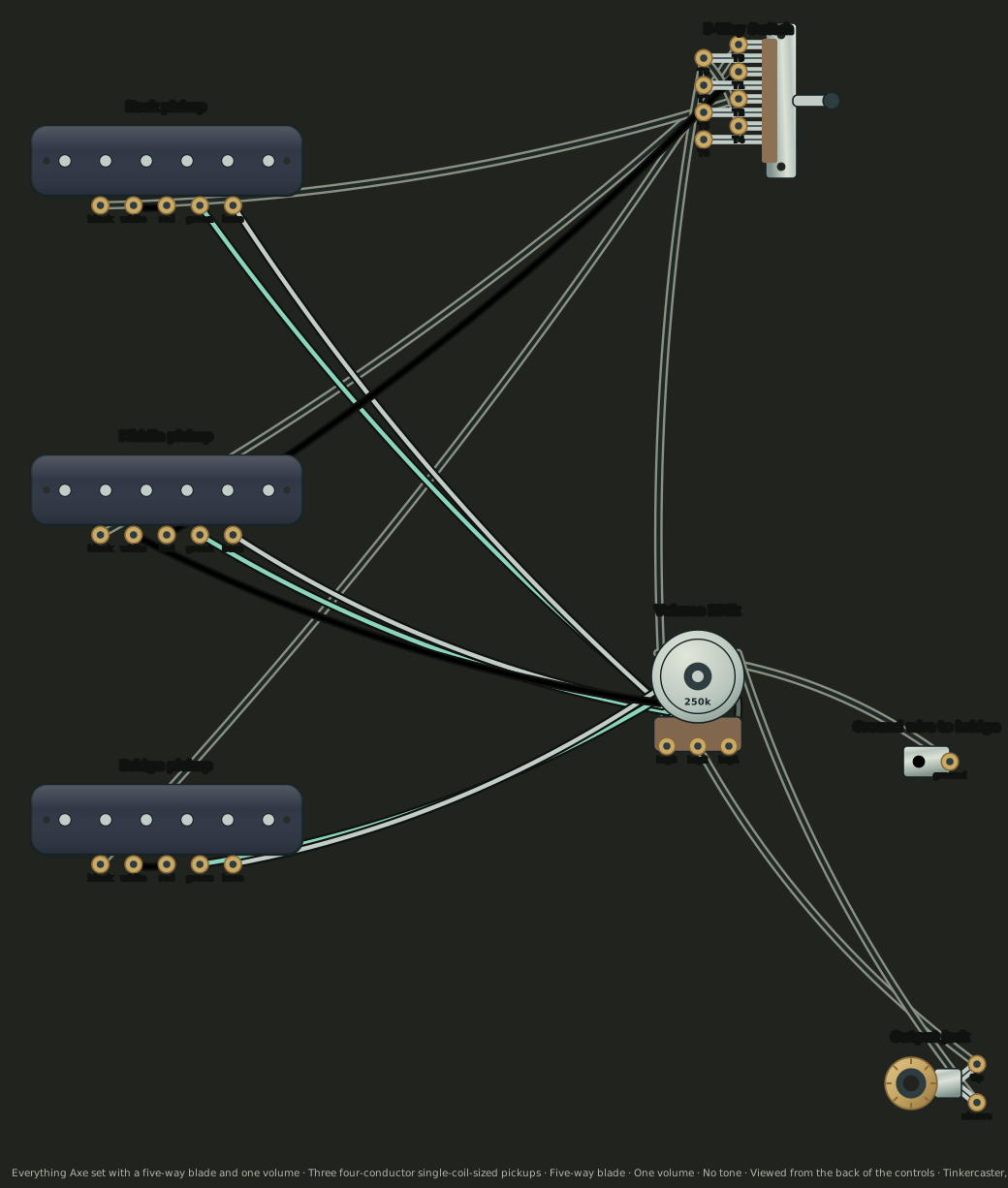
Everything Axe set, five-way blade, one volume, drawn by Tinkercaster from Seymour Duncan sheet EAX_1V. Open the full diagram for every connection.
This is the simplest sheet ([Seymour Duncan's original](https://www.seymourduncan.com/images/wiring-diagrams/EAX_1V.pdf)), and the other two build on it.
**Ground.** The volume casing has two solder spots. The upper one takes the green and bare from all three pickups, the middle pickup's white and the ground wire to the bridge. The volume's outer lug is bent over onto the casing at the lower spot, and a wire runs from there to the jack sleeve.
**Pickups to the switch.** The blade has two rows of four lugs. On the wired row, counting from the top of the drawing: bridge black on the first lug, middle black and red together on the second, neck black on the third. The fourth lug is that row's common.
**Switch to the jack.** A jumper runs from the common across to the top lug of the other row, and the volume feed is soldered there. From that lug a wire goes to the volume's input lug, and the volume's middle lug goes to the jack tip.
Seymour Duncan doesn't number the lugs or positions on the sheet, so our drawing maps them by what they do. That gives the standard Strat order:
| Position | What plays |
| --- | --- |
| 1 | Bridge (series humbucker) |
| 2 | Bridge and middle in parallel |
| 3 | Middle (coils in parallel) |
| 4 | Middle and neck in parallel |
| 5 | Neck (series humbucker) |
Positions 2 and 4 put a whole pickup in parallel with the middle. The middle is already two coils in parallel, so those positions are three coil paths side by side. Everything stays humbucking, so none of the five positions should hum. If one does, check the grounds first.
## Sheet 2: volume and one tone
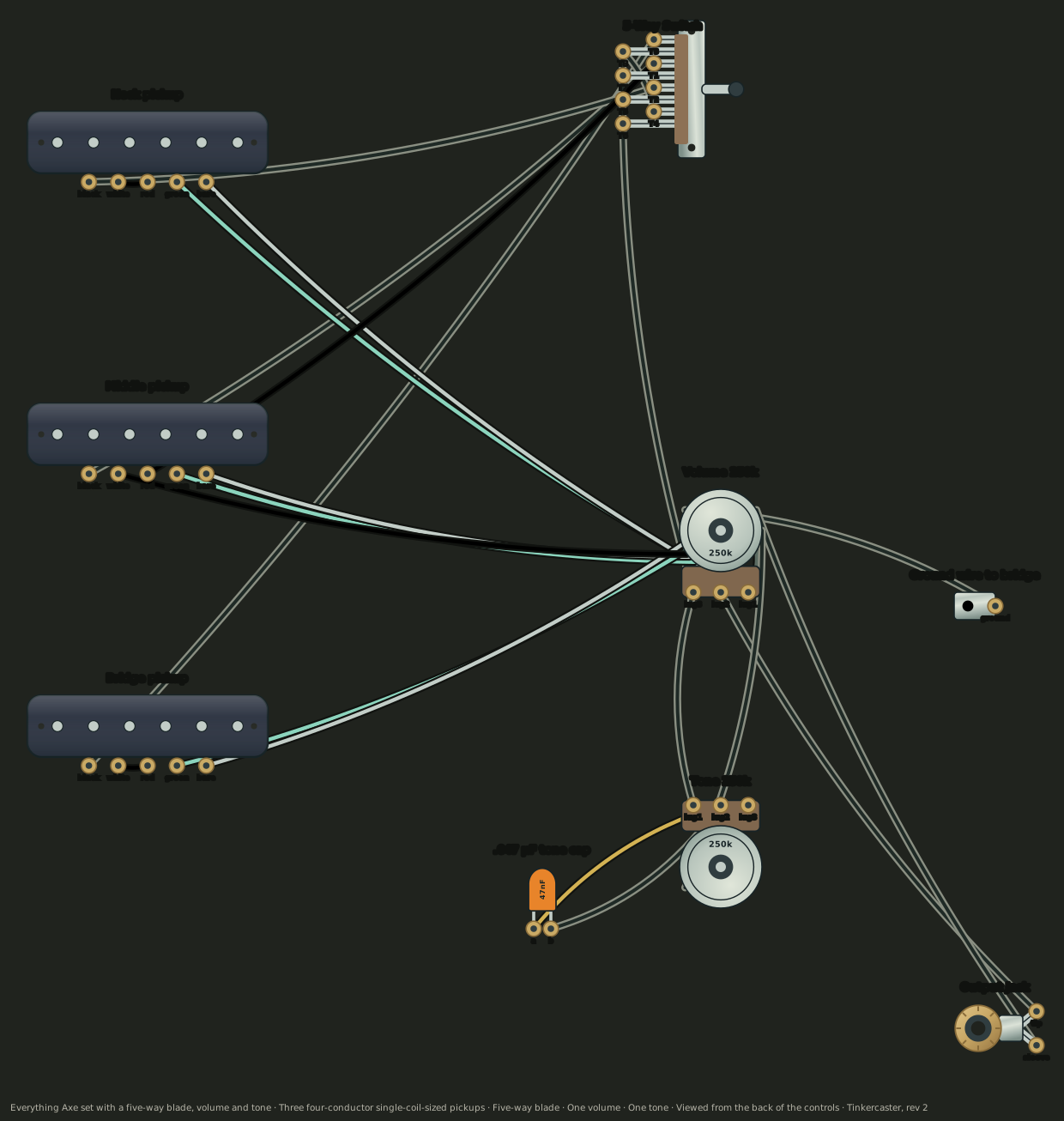
Everything Axe set, five-way blade, volume and tone, drawn by Tinkercaster from Seymour Duncan sheet EAX_1V_1T. Open the full diagram for every connection.
The [EAX_1V_1T sheet](https://www.seymourduncan.com/images/wiring-diagrams/EAX_1V_1T.pdf) wires the pickups, switch and volume exactly as on sheet 1 and adds a master tone:
1. A wire from the volume's input lug to the tone's first lug.
2. The .047 µF cap from the tone's middle lug to the solder spot on the tone's casing.
3. A wire from the tone casing to the volume's lower solder spot.
The tone hangs off the volume's input, so it works in all five positions. The cap belongs on the middle lug. The tone's third lug stays empty, and putting the cap there would leave the pot at a fixed 250k whatever the knob does.
## Sheet 3: volume and two tones
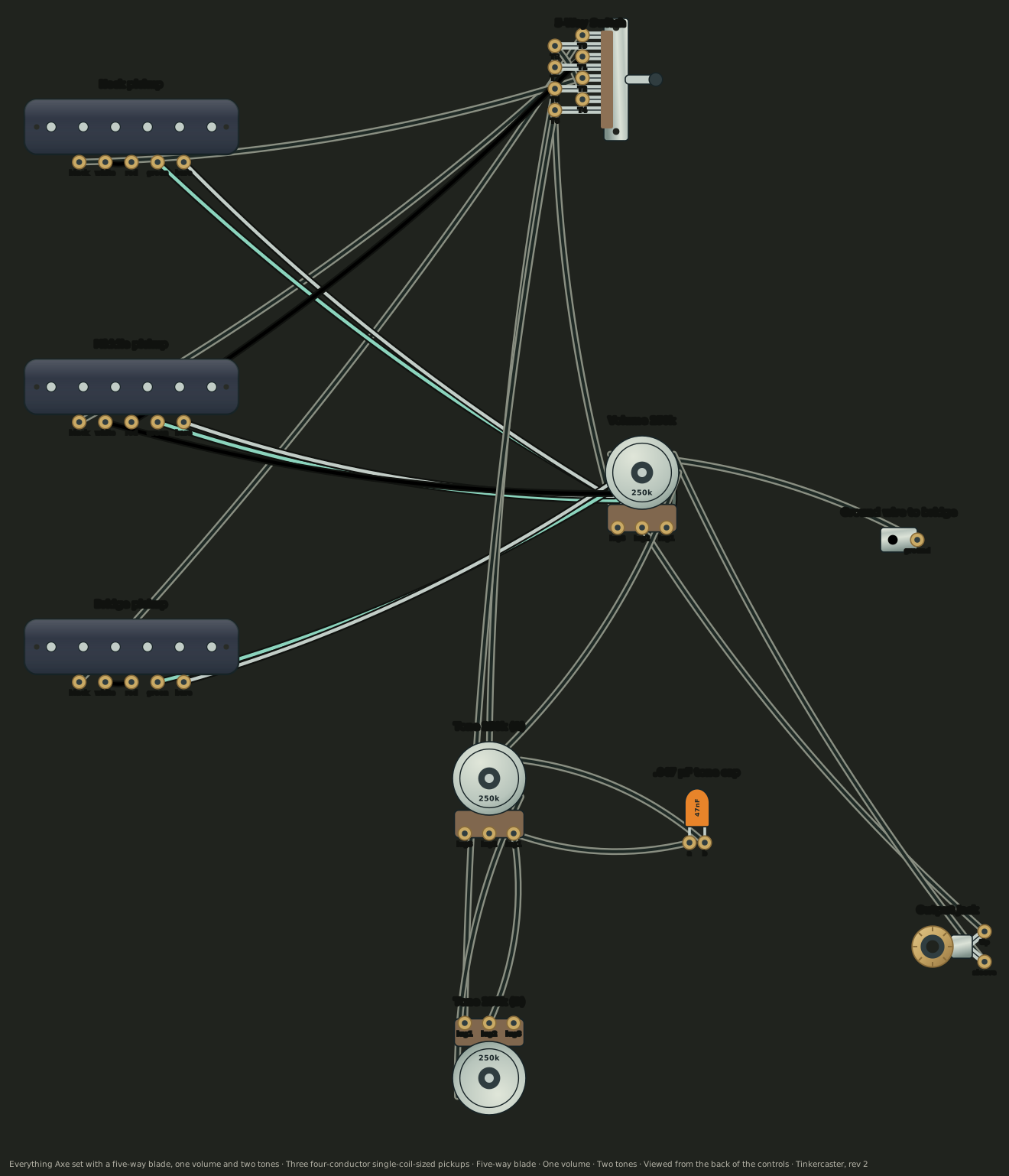
Everything Axe set, five-way blade, one volume and two tones, drawn by Tinkercaster from Seymour Duncan sheet EAX_1V_2T. Open the full diagram for every connection.
The [EAX_1V_2T sheet](https://www.seymourduncan.com/images/wiring-diagrams/EAX_1V_2T.pdf) uses the blade's second row to choose which tone is in circuit. The same trick is described in our [Strat 5-way switch article](/blog/how-to-wire-a-strat-5-way-switch). The pickups, ground and volume match sheet 1. The second row's top lug is its common, already fed by the jumper from the first row, so whatever it connects to sees the guitar's signal.
- A wire runs from the second row's third lug to the upper tone's (A) middle lug. The switch connects that row lug whenever the middle pickup is on, so tone A works in positions 2, 3 and 4.
- A wire runs from the second row's bottom lug to the lower tone's (B) first lug. The switch connects that row lug whenever the neck is on, so tone B works in positions 4 and 5.
- Both tones share one cap. Tone B's middle lug runs to tone A's third lug. The .047 µF cap goes from that lug to the solder spot on tone A's casing, so tone B reaches the cap through tone A's lug.
- The two tone casings are wired together, and tone A's solder spot is wired to the volume's lower solder spot.
The bridge has no tone in position 1, as on most Strats. In position 4 both tones are live. That's the same split as Seymour Duncan's [three single-coil Strat sheet](/wiring-diagrams/seymour-duncan/three-singles-five-way-volume-two-tones), which uses the second row the same way.
Switches from different makers don't all order their lugs the same way, so check yours with the meter test below. The same test shows which lug to use if you'd rather give the bridge a tone.
## Bench checks before you plug in
Do these with a multimeter on its resistance (ohms) range. If the meter is new to you, our [multimeter course](/courses/multimeter) covers setting it up and reading it.
**Before soldering, measure each pickup on its own leads.**
- Neck and bridge: twist red and white together, then measure black to green. Expect a reading near Seymour Duncan's listed 9.80k (neck) and 15.2k (bridge). Pickup readings vary a little from one unit to the next.
- Middle: twist red and white together and measure black to green (series). Then separate them, twist black with red and white with green, and measure across the two pairs (parallel). The parallel reading should be about a quarter of the series one. It's the number you'll see in position 3.
**After soldering, with the volume on 10, measure tip to sleeve at the jack.** On 10 the 250k volume sits across the pickups, so every reading comes out slightly lower than the pickup alone.
- Positions 1 and 5 read close to the bridge and neck figures.
- Position 3 reads the middle's parallel figure.
- Positions 2 and 4 read lower than either pickup on its own, because two pickups in parallel always read lower than the lower of the two.
- If position 3 reads close to the middle's series figure, the middle is wired in series: its red and white are joined, with black alone on the switch. If it reads about half the series figure, its white isn't grounded and only one coil is working.
- Turn the volume to 0: tip to sleeve should read close to zero.
**Check the taped joints.** On the neck and bridge, measure from the taped red and white joint to ground. You should see roughly half that pickup's reading, because the joint sits between the two coils and one coil leads to ground. If it reads zero, the joint is touching ground somewhere. If it reads open, one coil is broken or a lead is off.
**On the two-tone sheet, check the second row.** Turn both tones to 10. Put one probe on the volume's input lug and step through the positions:
- On tone A's middle lug, the meter should read near zero in positions 2, 3 and 4.
- On tone B's first lug, it should read near zero in positions 4 and 5.
Anywhere else the reading jumps to hundreds of kilohms or open, because the only path left runs through the pot tracks. If the near-zero positions come out different, your switch numbers its lugs differently. Move the tone wires before you close up the guitar.
## Questions guitarists ask
### Do I have to wire the middle in parallel?
No, but that's how Seymour Duncan designed the set. Every Everything Axe sheet runs the middle in parallel. Seymour Duncan's own description of the set says the middle is there for "sparkly single coil tone in positions 2, 3, & 4." In series the middle is louder and darker, so positions 2, 3 and 4 get thicker and lose that sparkle.
### Will the middle hum in parallel?
No. Both coils still pick up hum in opposite directions and cancel it, whether they're in series or parallel. What changes is the output and the brightness.
### Can I use 500k pots?
The sheets print 250k. A 500k pot loads the pickups less, so it sounds brighter, as our [250k vs 500k article](/blog/250k-vs-500k-pots) explains. The wiring is identical either way.
## Go further
- [How to wire a Strat 5-way switch](/blog/how-to-wire-a-strat-5-way-switch): the blade's two rows, lug by lug.
- [Series vs parallel wiring](/blog/series-vs-parallel-wiring): what each does to output and tone.
- [Seymour Duncan coil split on a Strat five-way switch](/blog/coil-split-wiring-seymour-duncan): splitting a humbucker on the same blade.
- [Courses](/courses): guitar wiring from your first joint to a full harness.
## Sources
- Seymour Duncan, [Everything Axe](https://www.seymourduncan.com/single-product/everything-axe): pickups, magnets, leads and DC resistances.
- Seymour Duncan sheets [EAX_1V](https://www.seymourduncan.com/images/wiring-diagrams/EAX_1V.pdf), [EAX_1V_1T](https://www.seymourduncan.com/images/wiring-diagrams/EAX_1V_1T.pdf) and [EAX_1V_2T](https://www.seymourduncan.com/images/wiring-diagrams/EAX_1V_2T.pdf), and our drawings of them: [one volume](/wiring-diagrams/seymour-duncan/everything-axe-five-way-volume), [volume and tone](/wiring-diagrams/seymour-duncan/everything-axe-five-way-volume-tone), [volume and two tones](/wiring-diagrams/seymour-duncan/everything-axe-five-way-volume-two-tones).
- Seymour Duncan, [Guitar wiring explored: humbucker internals](https://www.seymourduncan.com/blog/latest-updates/guitar-wiring-explored-humbucker-internals): the lead colours and series connection.