 Tinkercaster
Pickups & parts
250k vs 500k pots: which do you need?
Pot value is a load on your pickup's resonant peak. What 330 library diagrams specify for single coils, humbuckers, P90s and actives, how to read a CTS part number, and when to break the rule.
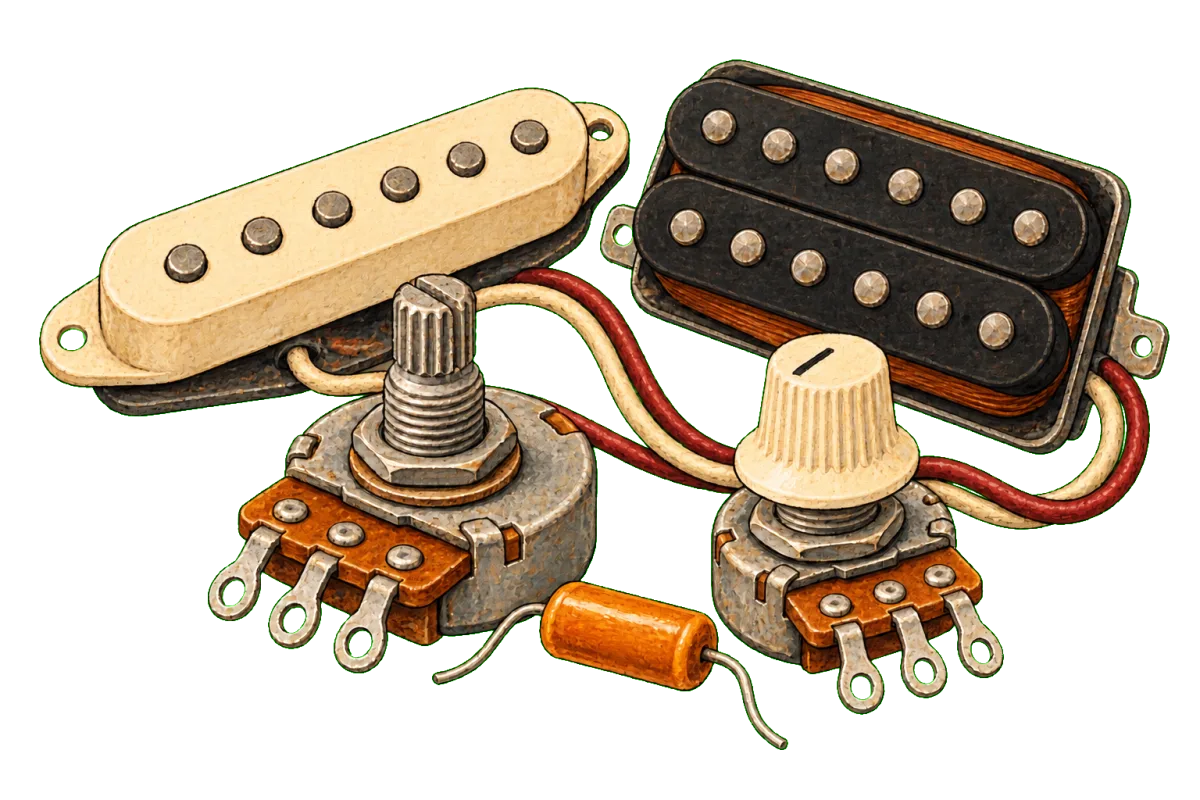
Use 250k pots with two-conductor single coils (Strat and Tele types) and 500k pots with full-size humbuckers and P90s. Active pickups are a separate case: use the value the pickup maker specifies, 25k for Seymour Duncan Blackouts and 100k for Seymour Duncan Live Wires, for example. A passive volume pot’s full track sits across the pickup, and a lower resistance damps the pickup’s resonant peak harder, so the guitar sounds darker. A higher value lets more treble through.
Makers mostly follow the convention, with some exceptions. In our library, 122 of 129 circuits built only from full-size humbuckers specify 500k, and every one of the seven exceptions is a Seymour Duncan Telecaster harness. Below we go through the mechanism and what the manufacturer sheets in our library specify, then taper, part numbers, measurement and the cases where a different value is the right call.
What a pot does to a passive pickup
A passive pickup is a coil: inductance, DC resistance and the capacitance between its windings. Together they behave as a low-pass filter with a resonant peak near the top of its range. Seymour Duncan’s 250k vs 500k article describes the pickup as a second-order filter with that resonance, and the volume pot as a resistive load on it: the lower the load, the harder it attenuates the high frequencies.
Follow the lugs on any standard volume control in our library and you can see why the load is there even at full volume. In Seymour Duncan’s two-humbucker sheet 2H_3G_1V_1T, the toggle output lands on the volume’s left lug (input), the middle lug (wiper) runs to the jack tip, and the right lug is bent onto the casing, which is ground. The whole resistive track therefore connects hot to ground, in parallel with the pickup, whatever the knob position. Turning the knob only moves the wiper. Fralin describes the same thing as an L-pad that “creates a short circuit across the signal” which damps highs “even when the pot is set to its maximum value” in its guide to volume and tone pots.
The tone control adds a second path. On the same sheet the volume’s input lug is jumpered to the tone pot’s left lug, the tone wiper goes to one leg of a .047 µF capacitor, and the capacitor’s other leg goes to the tone casing. With the tone at 10, the pickup still sees the tone track in series with the capacitor as another load to ground. That is why swapping the tone pot alone changes the sound with the knob fully up.
DiMarzio sums up the audible result in its FAQ answer Should I use 250K or 500K controls?: higher values “produce a little more power and treble response”. Its 4-conductor pickup instructions add that 500k is “the most common resistance value” for humbucker volume and tone, and that 250k controls give “a little warmer sound and a slight drop in power”.
What our library specifies
We counted the printed pot values in all 330 diagrams and grouped each circuit by the pickups it uses. Where the source sheet does not print a pot value, we counted it as “not printed” rather than trusting our own stand-in part. Bass circuits (16) are left out.
| Pickups in the circuit | 250k only | 500k only | Both values | Not printed |
|---|---|---|---|---|
| Two-conductor single coils only | 28 | 0 | 0 | 3 |
| Full-size humbuckers only | 7 | 122 | 0 | 1 |
| P90s only | 0 | 8 | 0 | 0 |
| P90 with a humbucker | 0 | 6 | 0 | 0 |
| P90 with a single coil (Tele) | 1 | 0 | 0 | 0 |
| P-Rails | 0 | 6 | 0 | 0 |
| Single-coil-sized humbuckers, stacks, rails and minis only | 41 | 2 | 3 | 0 |
| Single-coil-sized humbuckers with single coils | 7 | 0 | 0 | 6 |
| Full-size with single-coil-sized humbuckers | 2 | 9 | 0 | 0 |
| Humbuckers with single coils (HSS, HSH, Tele HS) | 31 | 9 | 4 | 3 |
Active circuits are separate. Six Seymour Duncan Blackouts diagrams specify 25k pots and nine Live Wire and Dave Mustaine diagrams specify 100k.
The table shows four patterns.
- Every guitar circuit built only from two-conductor single coils uses 250k wherever the sheet prints a value.
- P90s get 500k. All 14 circuits with only P90s, or a P90 with a humbucker, use 500k, which matches Fralin’s rule that P-90s take 500k pots. The one exception is Tonerider’s Tele with a P-90 style neck and a single-coil bridge, which keeps the Tele’s 250k.
- Single-coil-sized humbuckers mostly get 250k, because they go into Strat and Tele harnesses, and Seymour Duncan draws those harnesses with the instrument’s usual value.
- In mixed HSS and HSH circuits the value is the maker’s call: 31 use 250k throughout, 9 use 500k throughout and 4 use both.
The seven 250k humbucker circuits come from the same habit. All are Seymour Duncan Telecaster or Esquire sheets. The sheet for two humbuckers on a Tele blade, Tele_2H_3B_1V_1T, says the pickups “can be full humbuckers or single-coil-sized humbuckers” and specifies a 250k volume and a 250k tone either way.
Walkthrough: the same humbuckers on 250k and 500k
Compare two Seymour Duncan sheets that differ in instrument, not pickups.
Two humbuckers in a Tele harness, drawn by Tinkercaster from Seymour Duncan sheet Tele_2H_3B_1V_1T.
Parts, connections and bench checks ↗Open interactive diagram ↗Two humbuckers, three-way blade, one volume and one tone uses these parts:
- Neck and bridge: four-conductor humbuckers in Seymour Duncan colours
- 3-Way Switch: a Tele-style blade (catalog example: CRL 3-Way Blade)
- Volume 250k and Tone 250k (catalog example: CTS 250k Audio Pot)
- .047 cap (catalog example: Orange Drop .047µF)
- Output jack (catalog example: Switchcraft #11) and a bridge ground wire
The pot wiring sets the load. The switch output goes to the volume left lug (input), the right lug is bent onto the casing, and the middle lug goes to the jack tip. The volume left lug also runs to the tone left lug, the tone middle lug goes to the .047 cap, and the cap goes to the tone casing. Red and white on each pickup are soldered together and taped off as the series link; black goes to the switch; green and bare go to the volume casing.
| Blade position | What reaches the volume |
|---|---|
| Neck | Neck humbucker, both coils |
| Middle | Neck and bridge humbuckers in parallel |
| Bridge | Bridge humbucker, both coils |
The diagram’s bench checks, done with the meter across the jack:
- In each blade position, tip to sleeve reads the selected humbucker, or both in parallel in the middle.
- The red and white joint on each pickup touches neither ground nor any lug.
- With the volume at zero, tip and sleeve read as a short.
Now open Seymour Duncan’s 2H_3G_1V_1T, the same pickups on a Gibson-style toggle. The topology is almost identical: one volume, one tone, a .047 cap, red and white taped off. Only the pots differ. That sheet specifies a CTS 500k Audio Pot type for both controls, which the manufacturer’s PDF prints as “Volume 500k” and “Tone 500k”. Fit the same humbuckers to both harnesses and the Tele version loads them at half the resistance, so expect it to sound darker. The drawing tells you which value the maker chose; whether you prefer it is something to judge by ear on your own guitar.
The same pickups on 500k pots, drawn by Tinkercaster from Seymour Duncan sheet 2H_3G_1V_1T.
Parts, connections and bench checks ↗Open interactive diagram ↗Active pickups need the maker’s value
Active pickups contain a preamp. The coil drives the preamp, and the preamp drives the controls. The volume pot is no longer loading the coil’s resonance, so the 250k and 500k reasoning does not apply. Fit the value the maker chose for its own preamp output.
Two Blackouts with two 25K volumes, drawn by Tinkercaster from Seymour Duncan sheet 2BO_3G_2V.
Parts, connections and bench checks ↗Open interactive diagram ↗In two Blackout actives, two volumes, toggle, each Blackout’s hot lead goes to lug 3 of its own 25K volume. Lug 1 is grounded, and each wiper goes to a toggle lug. Both red leads share the battery positive junction, and the battery clip’s negative goes to the ring of a stereo jack (catalog example: Switchcraft #12B). Plugging in a mono cable connects ring to sleeve and completes the battery circuit. Seymour Duncan sells a 25k pot “specifically designed for Seymour Duncan active Blackouts pickups”.
The Dave Mustaine diagrams in our library specify 100K pots, as do the Live Wire single-coil diagrams. The Dave Mustaine set ships with its pots and capacitors, and Seymour Duncan notes that “active pickups require a special cap value”. Our catalog lists the EMG 25K Pot for EMG systems. EMG’s own pages refused our requests while we were writing, so check the value on the installation sheet that came with your EMG set.
Unplug the cable and take the battery out of its clip before you solder an active harness.
Audio, linear and custom taper
Taper describes how resistance changes with rotation, and it is independent of the total value. CTS defines its curves in the 450G datasheet by the percentage of total resistance at 50% rotation:
| CTS curve | Taper code | Resistance at 50% rotation |
|---|---|---|
| Std. D (linear) | 1 | 50% |
| C | 5 | 5% |
| A | 2 | 10% (“10% Audio”) |
| B | 4 | 15% |
| BD | 6 | 20% |
| H | 7 | 25% |
| J | 8 | 30% |
Fralin points out that hearing is not linear (it cites the Weber-Fechner law), so a linear volume does most of its audible work in a short part of the rotation. An audio curve spreads the change more evenly. Fralin prefers audio taper for both volume and tone. DiMarzio takes a third route: 55 of the 57 DiMarzio diagrams in our library call for its custom-taper pots (EP1200 250K, EP1201 500K). DiMarzio’s 500K custom taper page says they give a consistent “signal-to-turn ratio”. Our simulator models those pots as linear and says so on each diagram, so settings between the knob ends on those boards are approximate.
Reading a CTS part number
CTS builds its 450G part numbers field by field. The datasheet’s own example is 450G T 2 4 K 504 B 4 S:
| Field | Example | Meaning |
|---|---|---|
| Series | 450G | 24 mm guitar pot |
| Terminal | T | Solder lug |
| Bushing length | 2 | .250 in (6.35 mm) |
| Shaft length | 4 | .500 in (12.7 mm) |
| Shaft trim | K | Split knurl (R round, F flat) |
| Resistance | 504 | 50 followed by four zeros: 500 kΩ |
| Tolerance | B | ±20% (A is ±10%) |
| Taper | 4 | 15% audio (curve B) |
| Torque | S | Standard (L is low) |
The resistance code works like a resistor code: 253 is 25 kΩ, 503 is 50 kΩ, 104 is 100 kΩ, 254 is 250 kΩ, 504 is 500 kΩ and 105 is 1 MΩ. The part number describes what you order. The stamp on a particular pot body varies with batch and supplier, so if the markings are missing or unclear, measure it.
Measuring a pot
Measure the pot out of circuit, or with at least one outer lug lifted. In a harness, the pickup, the other pots and the capacitor all sit in parallel with the track, and the reading comes out low.
- Set the meter to a resistance range above the nominal value (2 MΩ for a 500k pot).
- Measure between the two outer lugs. That is the whole track and should not change as you turn the shaft.
- Measure from the wiper to each outer lug in turn. One reading rises as the other falls, and at either end stop the wiper reads close to zero to one lug.
- To check the taper, set the shaft to its mid-rotation point and measure from the wiper to lug 1, the counter-clockwise end in our catalog’s terminal map. A CTS curve A pot reads about 10% of the total there. A linear pot reads about half.
Judge the result against the tolerance. At the CTS standard of ±20%, a 500k pot is in specification anywhere from 400k to 600k and a 250k pot from 200k to 300k. Fralin gives the example of a 250k pot that measures around 243K. If you want matched brightness between two guitars, measuring and choosing your pots does more than buying from the same bag.
When to break the convention
DiMarzio states that “you won’t damage your pickups or your amp by mixing and matching different value controls”, and suggests trying a 250K volume with a 1 Megohm tone. You can treat the value as a voicing control:
- Seymour Duncan’s own Tele sheets keep 250k with humbuckers. If a dark humbucker sounds muddy in your Telecaster on 250k, 500k is a legitimate change.
- 250k is the default for single coils, but Lindy Fralin’s own advice is that you might like 500K on them if they sound dull. Fralin also sells 300K pots, a little brighter than 250K.
- In an HSS guitar one value cannot suit both pickup types. Fender’s service drawing for the American Standard Stratocaster HSS Shawbucker lists a “CONTROL 500K/250K SPLIT” dual volume alongside separate 500K and 250K controls. Our catalog records it as the Fender Dual 500k/250k split-shaft.
- For extra treble only when the tone is up, a 1M tone pot (catalog: CTS 1M Linear Pot) reduces the load of the tone path without changing the volume.
The capacitor sets where the tone control cuts, while the pot value sets how much the resting circuit loads the pickup. Each maker in our library has a default capacitor. Seymour Duncan sheets specify .047 µF in 136 diagrams and .022 µF in 11, DiMarzio uses .022 µF in 39 and .033 µF in 13, and Tonerider uses .022 µF in 38. DiMarzio’s 4-conductor instructions recommend .022 µF. The modern wiring on Fender’s American Vintage Tele diagram draws 250K pots with a .05 µF capacitor.
Fitting the new pots
CTS lists the 450G soldering condition as a maximum of 260 °C for 5 seconds, so prepare each joint before the iron touches the pot. Work with fume extraction and wash your hands after handling leaded solder. Never solder a guitar that is plugged into an amp. Our soldering guide and soldering cheat sheet cover the technique, and the multimeter course covers component measurement in depth. If swapping pots has left a pickup silent, work through how to fix a dead pickup.
Next step
Open Seymour Duncan’s Tele two-humbucker harness beside its 500k toggle equivalent and compare the parts lists. The library and catalog of potentiometers are free to browse, and copying a diagram onto your own board to swap the pots and keep the bench checks with it is free too. Tinkercaster Pro adds Luthier, the AI assistant (with a usage limit), and guided builds. For the related switching question, read series vs parallel wiring. To identify leads before you fit anything, see Gibson vs Fender pickup wire colour codes.
References
From the Tinkercaster library
- Two humbuckers, three-way blade, one volume and one tone (Seymour Duncan Tele_2H_3B_1V_1T): 250k pots with humbuckers in a Tele harness.
- Two humbuckers, three-way toggle, one volume and one tone (Seymour Duncan 2H_3G_1V_1T): pot lug roles, 500k pots, .047 cap.
- Two Blackout actives, two volumes, toggle (Seymour Duncan 2BO_3G_2V): 25K pots, stereo jack battery switching.
- Dave Mustaine actives, toggle, master volume and three Live Wire singles, volume and tone: 100K pots.
- Catalog: CTS 250k Audio Pot, CTS 500k Audio Pot, CTS 1M Linear Pot, EMG 25K Pot, Fender Dual 500k/250k split-shaft, CRL 3-Way Blade, Orange Drop .047µF, Switchcraft #11, Switchcraft #12B.
- Courses: Using a multimeter for guitar wiring, The wiring course.
Manufacturer and technical sources
- Seymour Duncan: 250K vs 500K pots: pickup as a resonant second-order filter; a lower pot load attenuates highs harder.
- DiMarzio: Should I use 250K or 500K controls?: higher values give more power and treble; mixing values does no damage; 250K volume with 1M tone.
- DiMarzio: 4-Conductor Pickup Instructions: 500k as the most common humbucker value, 250k warmer, 1M tone option, .022 µF recommendation.
- DiMarzio: 500K Custom Taper Potentiometer: custom taper description.
- CTS Series 450G datasheet: ordering code, resistance codes, ±20%/±10% tolerance, taper curves by resistance at 50% rotation, 260 °C for 5 s soldering condition.
- Fralin: How do volume and tone pots work?: pot as an L-pad that damps highs at full rotation, P-90s on 500k, measuring across the outer lugs, tolerance example, audio taper preference, 300K pots.
- Seymour Duncan sheet 2H_3G_1V_1T: Volume 500k and Tone 500k with two humbuckers.
- Seymour Duncan 25k pot for Blackouts: 25k value for Blackouts.
- Seymour Duncan Dave Mustaine set: pots and a special cap value supplied with the active set.
- Fender American Standard Stratocaster HSS Shawbucker service manual: 500K/250K split dual volume in an HSS guitar.
- Fender American Vintage Tele pickups wiring diagram: 250K pots and a .05 µF capacitor with Tele single coils.