 Tinkercaster
Pickups & parts
How to wire a P90
P90 lead types by maker, soapbar vs dog-ear, and our Tonerider and Seymour Duncan P90 diagrams walked through: one pickup, two on a toggle, and P90 with a humbucker.
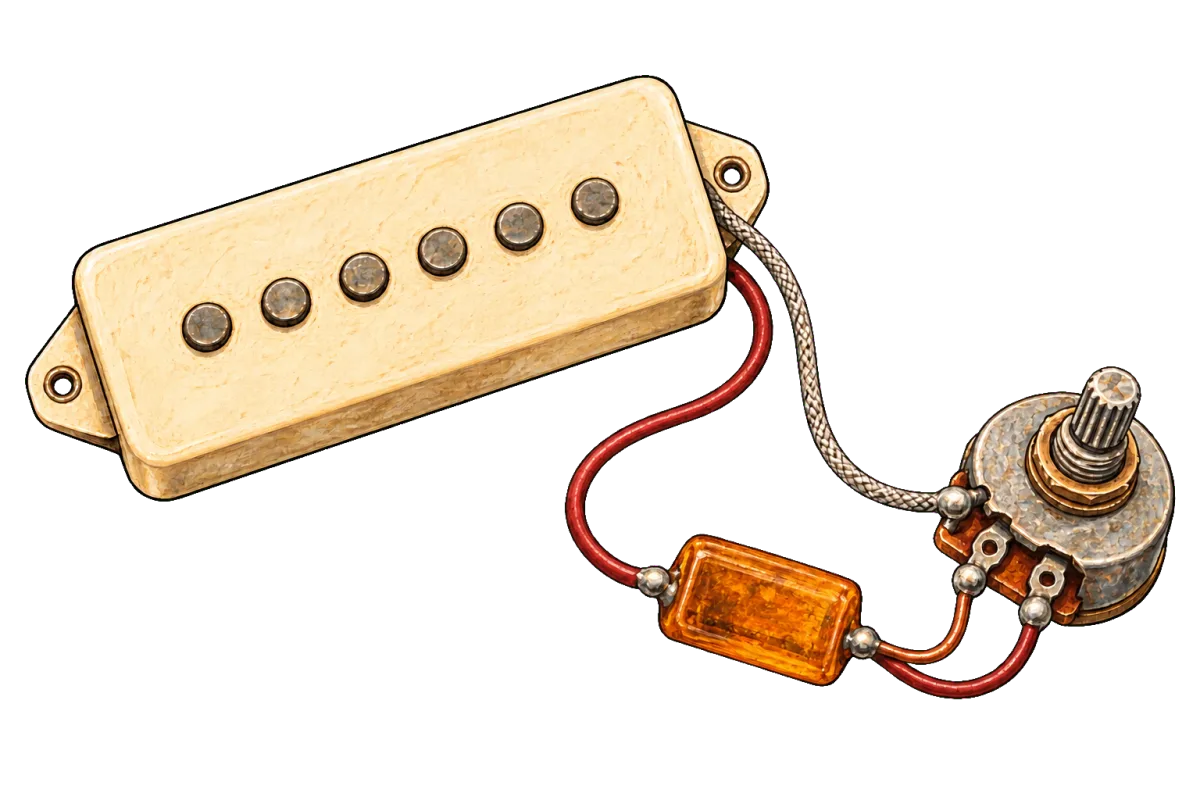
A standard P90 is a single-coil pickup with one hot and one ground, so it wires like any two-wire single coil: hot to the volume’s input lug, ground and shield to the back of a pot. Soapbar and dog-ear P90s wire the same way; only the mounting differs. In our library, P90 circuits use 500k pots and a .022 µF or .047 µF tone capacitor. The lead is what varies, and what one maker calls “two-conductor” is not always the same cable another maker means.
This article covers identifying the lead, then walks through the P90 diagrams in our library connection by connection. There are three Tonerider sheets (one pickup, one pickup without a tone control, two pickups on a toggle) and a Seymour Duncan P90 and humbucker sheet for comparison.
Identify the lead before you solder
Makers describe P90 leads in different ways, and the words do not map one to one.
| Pickup | How the maker describes the lead | What you connect |
|---|---|---|
| Gibson P-90 Soapbar | “Vintage, braided two-conductor wiring” | Centre conductor is hot, braid is ground |
| Seymour Duncan Vintage P90 | “Vintage braided single-conductor hookup cable” | Centre conductor is hot, braid is ground |
| Tonerider P90s (our drawings) | White and black leads plus a “Bare Shield Wire” | White is hot, black and bare shield go to ground |
| Seymour Duncan P90 Stack | Four-conductor shielded lead | Two coils: follow the maker’s colour sheet |
Gibson and Seymour Duncan are describing the same construction: one insulated conductor inside a braided shield. Gibson counts the braid as a conductor and Seymour Duncan does not, so go by the cable in your hand. If there is one insulated wire inside a braid, the braid is your ground. If there are two insulated wires and a bare wire, the colour sheet for that pickup tells you which is hot.
Four-conductor P90s are a different device. The Seymour Duncan P90 Stack has two stacked coils, and the product page says its lead lets you “split the coils if you want, or to switch into series mode”. The Seymour Duncan Custom Shop P90 Dog Ear Stack also ships with a four-conductor lead “for series or parallel wiring”. Wire one of those like a small humbucker, from the maker’s diagram; the two-wire circuits below don’t apply. Our catalog lists the STK-P1 P-90 Stack as four-conductor with two coils and hum cancelling.
Soapbar and dog-ear: same wiring, different mounting
A soapbar P90 mounts with two screws set close together through the cover. A dog-ear P90 has a cover with an ear at each end, and the mounting screws go through the ears. StewMac’s P-90 cover listing gives the difference in numbers: import soapbar covers have mounting screws about 25/32 in (19.84 mm) apart and dog-ear covers about 3-13/16 in (96.84 mm) apart. StewMac’s dog-ear bracket exists so a P90 can be surface mounted under a dog-ear cover, “as on Les Paul Juniors, SGs, and many archtop guitars”.
The mounting style doesn’t change the circuit. Gibson’s Custom 1960 Les Paul Junior pairs a dog-ear P-90 with CTS 500k audio taper volume and tone pots, the same values Gibson lists for the two P-90s on its Custom 1957 Les Paul Special (“2 Volume, 2 Tone, Hand-wired with 500k CTS Potentiometers”). Check the route depth and screw positions for fit. Wire the lead the same way either way.
One P90, volume and tone
The simplest complete circuit in our library is our drawing of Tonerider sheet 1_P90_1V_1T.
One P90, volume and tone, drawn by Tinkercaster from Tonerider sheet 1_P90_1V_1T.
Parts, connections and bench checks ↗Open interactive diagram ↗The parts: one P90 (two-conductor), Volume 500kA, Tone 500kA, a .022 µF capacitor, a mono output jack and a bridge ground wire. The diagram gives a CTS 500k Audio Pot, an Orange Drop .022µF and a Switchcraft #11 as compatible examples.
The connections, in the diagram’s order:
- P90 black lead and bare shield wire to the volume casing.
- Volume right lug bent onto its casing.
- Tone right lug bent onto its casing.
- Tone casing linked to the volume casing.
- Jack sleeve to ground.
- Ground wire from the bridge to the volume casing.
- P90 white lead to the volume’s left lug.
- Volume middle lug (wiper) to the jack tip.
- One leg of the .022 µF capacitor to the volume’s left lug.
- The other leg to the tone’s middle lug.
The pickup feeds the top of the volume track (left lug) and the bottom of the track is grounded (right lug). The wiper picks off a fraction for the jack, so turning down moves the wiper towards ground. The tone circuit is a capacitor in series with a variable resistance to ground. This sheet puts the capacitor first, from the signal to the tone wiper, with the tone’s right lug grounded: the diagram calls it “cap-before-pot”. Turning the tone down reduces the resistance in series with the capacitor, so more treble goes to ground. The other common arrangement feeds the tone’s outer lug and puts the capacitor between the wiper and ground. Electrically the two are the same; only the lug the capacitor lands on changes.
The 500k value matters for brightness. Seymour Duncan’s pots and caps guide says “with higher-value pots, more frequencies are allowed to pass through the pot”, giving a brighter signal. Both pot tracks sit across the pickup as a load, the volume track at DC and the tone track through its capacitor at audio frequencies. A higher-value track draws less treble away from the pickup. Seymour Duncan’s deeper article on 250k and 500k pots describes the pot as a load on the pickup that draws current “in the higher frequencies”. Our article on 250k vs 500k pots goes further.
Tonerider also draws the same pickup with no tone control: one P90 with one volume (sheet 1_P90_1V). It is the same volume and ground wiring as above, into a 500kA volume, without connections 3, 4, 9 and 10. The diagram’s bench checks apply to both: with the volume up, the meter across the jack reads the P90’s resistance, and the jack sleeve reads continuity to the volume casing and the bridge ground wire.
Two P90s on a three-way toggle
For a Les Paul Special or Junior style guitar with two P90s, Tonerider draws two layouts. The simpler one, sheet 2_P90_1V_1T_3-way_toggle, uses one master volume and one master tone.
Two P90s with a three-way toggle, one volume and one tone, drawn by Tinkercaster from Tonerider sheet 2_P90_1V_1T_3-way_toggle.
Parts, connections and bench checks ↗Open interactive diagram ↗The parts are two P90s, a three-way toggle (compatible example: Switchcraft 3-Way Toggle), Volume 500kA, Tone 500kA, .022 µF, output jack, bridge ground wire. The sheet says it covers “ALL P90 PICKUPS”.
The connections:
- Neck white to the toggle’s upper outer lug. Bridge white to the lower outer lug.
- Each pickup’s black lead and bare shield wire to the toggle’s frame lug, which is grounded.
- Toggle middle lug to the volume’s left lug, which also feeds the tone’s left lug.
- Volume middle lug to the jack tip. Volume right lug linked to its casing.
- Tone middle lug through the .022 µF capacitor to the tone casing. The tone’s right lug is drawn empty.
- Tone casing, jack sleeve and the bridge ground wire to ground.
Grounding the pickups at the toggle frame is what the sheet shows: the frame lug, both pot casings and the jack sleeve all carry its ground symbol. Our drawing wires each of those to the volume casing and notes that this is a routing choice, not a solder point on the source. The toggle lugs are not labelled on the sheet, so the diagram maps them by function. Find the outer pickup lugs and the frame lug on your switch with the meter first. The article on wiring a humbucker to a 3-way toggle sets out that procedure for a Switchcraft-style toggle.
| Toggle position | What is connected | Meter across the jack, volume up |
|---|---|---|
| Neck (up) | Neck P90 | Neck P90’s resistance |
| Middle | Both P90s in parallel | Lower than either pickup alone |
| Bridge (down) | Bridge P90 | Bridge P90’s resistance |
| Any, volume at zero | Wiper at ground | A short |
The sheet does not label the toggle positions. The diagram uses the usual neck, both, bridge order, and it gives no numeric readings because the sheet specifies no pickup resistance. Measure each pickup on its own before you fit the harness, then compare.
Two volumes and two tones
The Gibson layout, sheet 2_P90_2V_2T_3-way_toggle, gives each pickup its own volume and tone, all four 500kA, with a .022 µF capacitor on each tone. The order of parts changes:
- Each pickup’s white lead goes to its own volume’s left lug. Its black lead and bare shield go to that volume’s casing.
- Each tone is cap-before-pot, fed from its volume’s left lug, with the tone’s right lug bent to its casing.
- Each volume’s middle lug runs to the toggle: neck to the upper outer lug, bridge to the lower outer lug.
- The toggle’s middle lug goes to the jack tip.
With the volume wipers feeding the toggle, the two volumes interact in the middle position. Both wipers join at the toggle output, so turning either volume fully down grounds that shared point and mutes both pickups. The layout is meant to do this. Check it on the bench: in the middle position with one volume at zero, tip to sleeve should read a short.
A P90 with a humbucker: two makers compared
Our library has two sheets for a P90 neck and a humbucker bridge, and they differ in more than the controls.
P90 neck and humbucker bridge with a three-way toggle, drawn by Tinkercaster from Tonerider sheet 1_P90_1_HB_1V_1T.
Parts, connections and bench checks ↗Open interactive diagram ↗| Tonerider 1_P90_1_HB_1V_1T | Seymour Duncan 1PC_1H_3G_2V_1T | |
|---|---|---|
| Neck pickup | P90: white hot, black and bare shield to ground | Phat Cat: single braided lead, centre conductor hot, braid to ground |
| Humbucker hot | Red, to the toggle | Black, to the bridge volume |
| Humbucker ground | Green and bare shield | Green and bare shield |
| Series link (join and insulate) | Black and white | Red and white |
| Controls | One 500kA volume, one 500kA tone | Two 500k volumes, one 500k master tone |
| Tone capacitor | .022 µF | .047 µF |
The humbucker colours are where rewires go wrong. Tonerider’s sheet prints “Solder Black and White wires together, and insulate with heat shrink or electrical tape”, with red as hot. Seymour Duncan’s sheet joins red and white and uses black as hot. Follow the sheet for the humbucker you actually have, and read the Seymour Duncan wire colour guide or our article on Gibson vs Fender pickup wire colour codes if your pickups come from different makers. The Seymour Duncan diagram adds a bench check that applies to any four-conductor humbucker: the taped series joint should read open to ground. The Phat Cat is Seymour Duncan’s P90 in a humbucker-sized cover, and our catalog lists the SPH90-1 bridge model.
What our library shows about P90 pot values
We counted the diagrams whose title or spec line names a P90, P-90 or Phat Cat. There are 13 in our library: Tonerider’s P90 sheets, Seymour Duncan’s Phat Cat and P-Rails sheets (the P-Rails has a P-90 mode), and a Tonerider Tele with a Rebel 90 neck. Twelve use 500k pots. The exception is the Tele with a neck Rebel 90 and a Tele bridge pickup, which uses 250k: the value Tonerider also draws on its standard Telecaster sheet. There the P-90 style neck shares its controls with a Tele bridge single coil.
Hum, and what to do about it
A standard P90 is one coil, so it hums like any single coil. Our catalog records the Gibson P-90 Soapbar as not hum-cancelling. With two P90s, the middle position cancels hum only if the pickups are a matched pair wound and magnetised in opposite directions, the arrangement Seymour Duncan calls reverse wound, reverse polarity on its Antiquity Jazzmaster page. The Tonerider sheets do not state this, so our diagrams do not claim it. Check the maker’s specification for your set. If you need a quiet P90-sized pickup, the stacked designs above are built for that: Seymour Duncan sells the P90 Stack as a noiseless P90.
Shielding and grounding help with buzz from outside the pickup, but they do not stop a single coil picking up hum. The article on why a guitar buzzes separates the two, and how to shield a guitar cavity covers the cavity side.
At the bench
Unplug the guitar from any amp before soldering. Braided shield takes heat quickly and wicks solder up the braid. Tin a short length, keep it clear of the centre conductor, and make sure no loose strand can reach the hot lug. The soldering cheat sheet and our guide on how to solder guitar wiring cover joint technique, and a dead pickup is often a braid strand shorting the hot to ground. Before you close the cavity, meter every toggle position and every volume at zero as in the tables above. The multimeter course explains what each reading can and cannot prove.
Build it from a diagram
Start with the two P90s, three-way toggle diagram or the one P90 volume and tone diagram, and check the lead on your pickup against the table at the top. The library, catalog and courses are free, and so is opening the diagram in the workbench to save and customise your own board (for example, moving to the two-volume layout or swapping the capacitor). With Tinkercaster Pro you can also ask Luthier about a connection and follow a guided build with meter checkpoints.
References
From the Tinkercaster library
- One P90, volume and tone (Tonerider 1_P90_1V_1T): parts, connection list, cap-before-pot tone.
- One P90 with one volume (Tonerider 1_P90_1V): volume-only circuit and bench checks.
- Two P90s with a three-way toggle, one volume and one tone (Tonerider 2_P90_1V_1T_3-way_toggle): toggle wiring, position table, bench checks.
- Two P90s, toggle, two volumes and two tones (Tonerider 2_P90_2V_2T_3-way_toggle): Gibson-style layout.
- P90 neck and humbucker bridge (Tonerider 1_P90_1_HB_1V_1T) and Phat Cat neck and humbucker bridge (Seymour Duncan 1PC_1H_3G_2V_1T): the maker comparison.
- Tele with a neck Rebel 90 and a Tele bridge pickup and Standard Telecaster wiring (Tonerider): the one 250k exception and its Tele reference.
- Catalog: CTS 500k Audio Pot, Orange Drop .022µF, Switchcraft 3-Way Toggle, Switchcraft #11, Gibson P-90 Soapbar, Seymour Duncan STK-P1 P-90 Stack, Seymour Duncan Phat Cat SPH90-1 Bridge.
- Guides and courses: Seymour Duncan wire colours, multimeter course, soldering cheat sheet.
Manufacturer and technical sources
- Gibson: P-90 Soapbar pickup: “vintage, braided two-conductor wiring”; single coil, Alnico 5, 8K average DC resistance.
- Gibson: Custom 1960 Les Paul Junior: dog-ear P-90 with CTS 500k audio taper volume and tone.
- Gibson: Custom 1957 Les Paul Special: two volumes and two tones on 500k CTS pots.
- Seymour Duncan: Vintage P90: vintage braided single-conductor hookup cable.
- Seymour Duncan: P90 Stack: four-conductor lead for split or series; hum-free P90 tone.
- Seymour Duncan Custom Shop: P90 Dog Ear Stack: four-conductor lead for series or parallel wiring in a dog-ear route.
- Seymour Duncan: best guitar pots and caps: higher pot values pass more treble; capacitor values.
- Seymour Duncan: 250K vs 500K pots, going deeper: the pot as a load that draws high-frequency current.
- StewMac: P-90 pickup cover: soapbar and dog-ear mounting screw spacing.
- StewMac: P-90 dog-ear bracket: surface mounting a P90 under a dog-ear cover.
- Seymour Duncan: Antiquity Jazzmaster: reverse wound, reverse polarity pairing for hum cancelling with two pickups.
- Tonerider: wiring diagrams: Tonerider’s list of P90 wiring sheets.