 Tinkercaster
Wiring ideas
How to wire an HSH guitar with a five-way switch
Two humbuckers and a single coil on a Strat five-way blade, from DiMarzio and Tonerider sheets: lead by lead, the auto-split in positions 2 and 4, and a mini-toggle split.
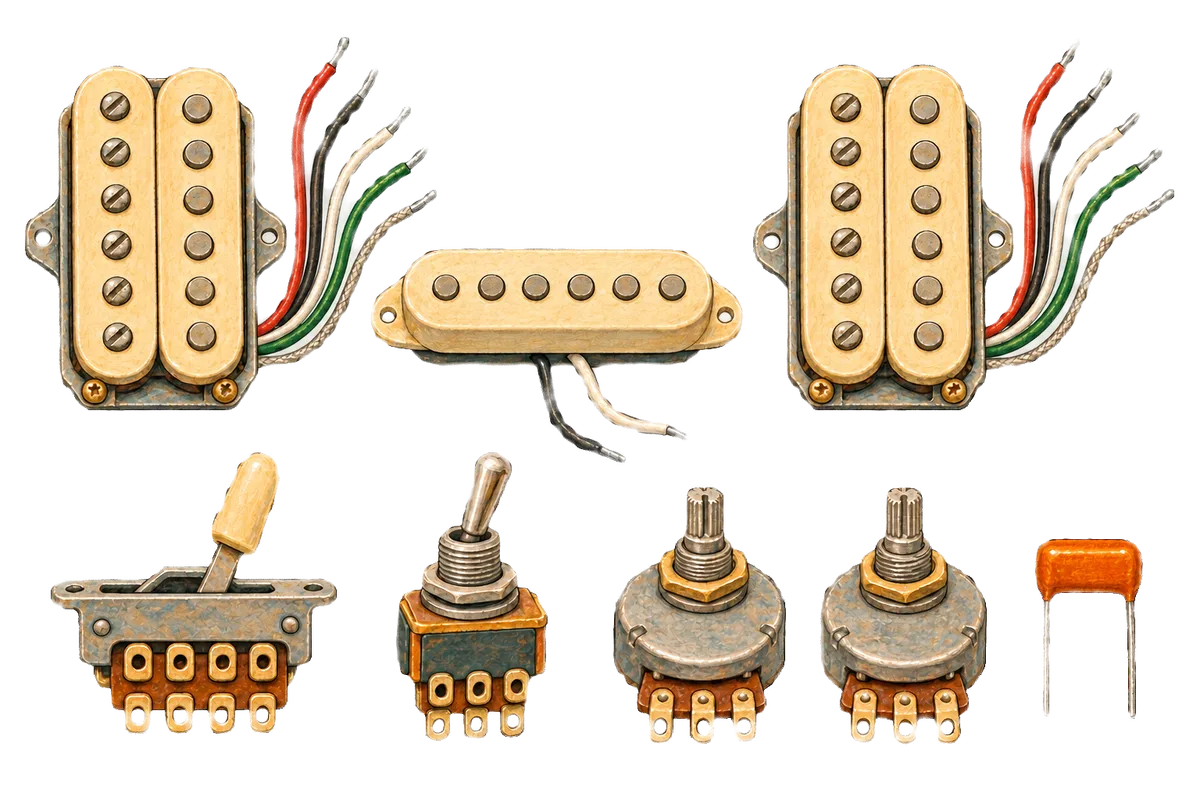
An HSH guitar puts a humbucker at the neck, a single coil in the middle and a humbucker at the bridge, all on a Strat-style five-way blade. In DiMarzio’s two HSH sheets, each humbucker’s hot goes to the blade’s first row, its series link goes to the second row, and that second row splits the humbucker in the two in-between positions, so positions 2 and 4 pair one coil of a humbucker with the middle pickup.
This article walks through those DiMarzio sheets connection by connection, then compares a Tonerider sheet that leaves the blade alone and splits both humbuckers from a DPDT mini-toggle instead. It applies to a standard five-way blade for Strat (DiMarzio part EP1104, an Oak Grigsby 5-Way in our drawings), two four-conductor humbuckers and a two-wire single coil.
The DiMarzio HSH harness
DiMarzio’s sheet Humbucker/Standard Single/Humbucker (PDF) is the plain version: one volume, one tone, a .022µF capacitor and a two-conductor Switchcraft output jack. Our drawing of it is HSH five-way with volume and tone.
DiMarzio HSH, five-way, volume and tone, drawn by Tinkercaster from the sheet "Humbucker/Standard Single/Humbucker".
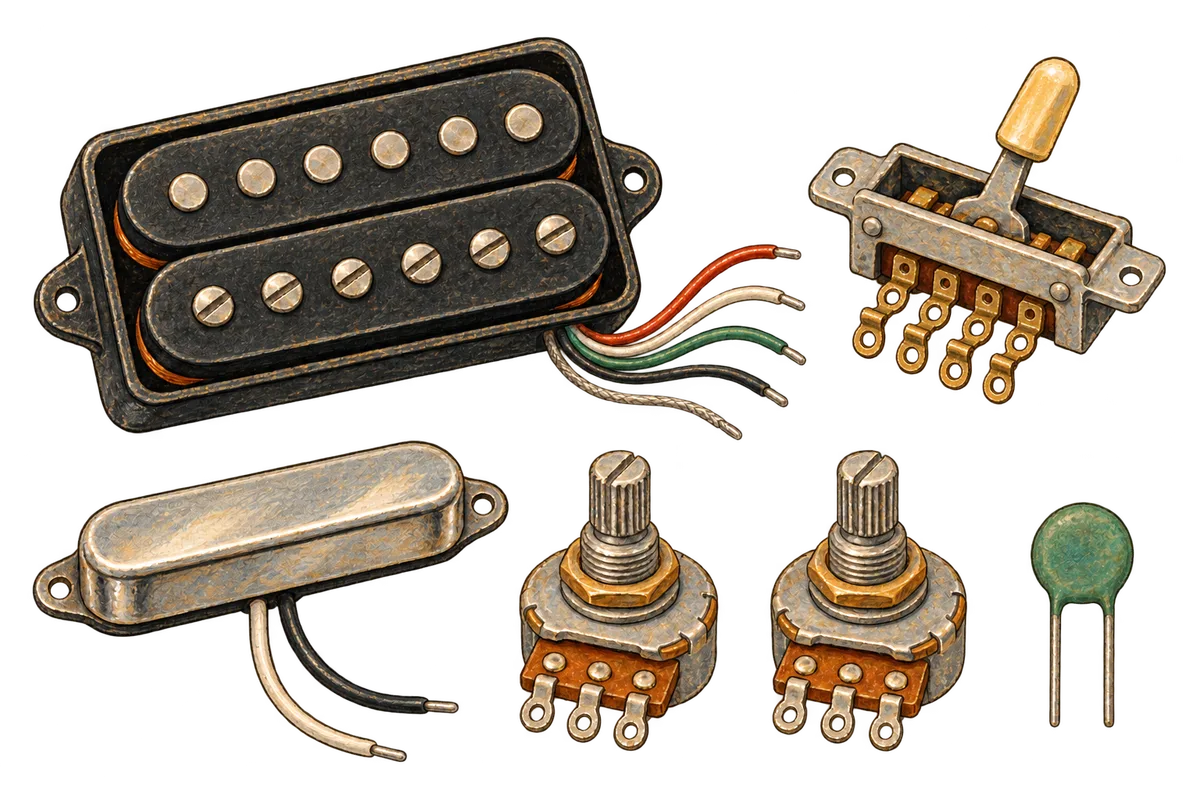
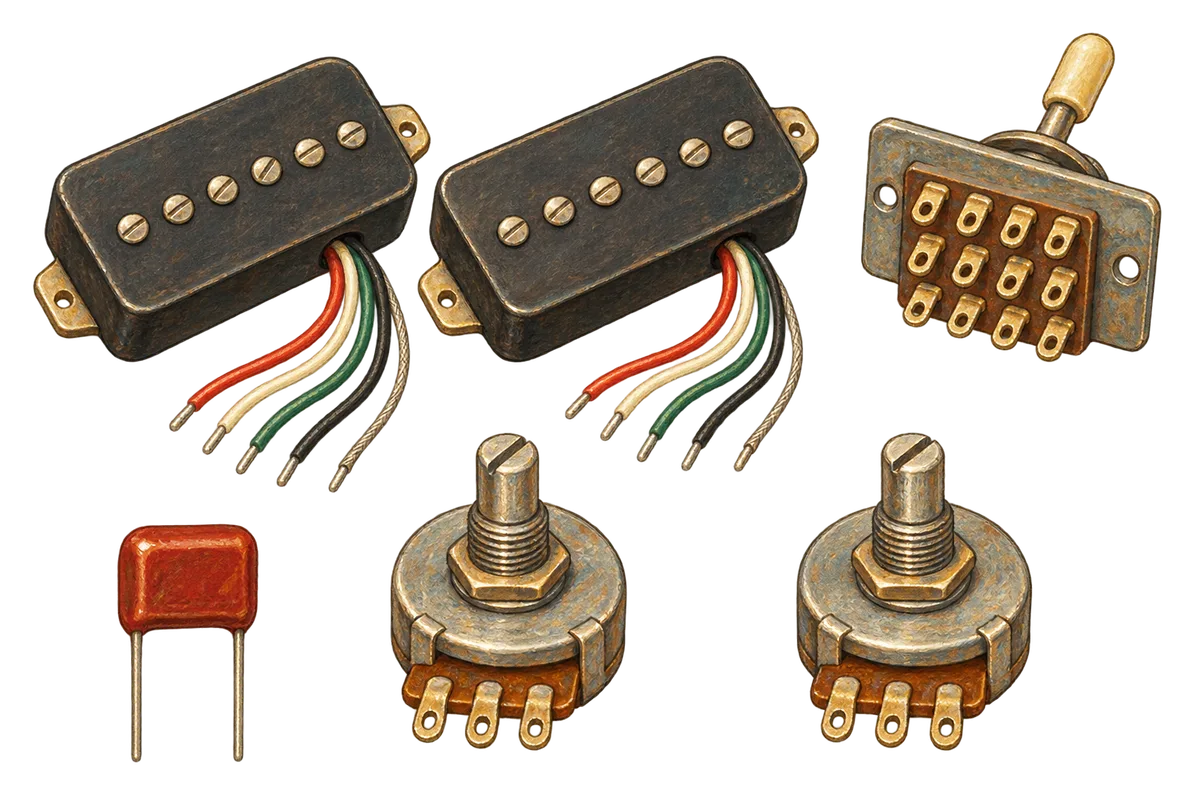
Parts, connections and bench checks ↗Open interactive diagram ↗The parts on the sheet: two humbuckers, a standard single coil marked “reverse polarity (south)” for the middle, the five-way switch, a 500K custom taper volume pot and a 500K custom taper tone pot (DiMarzio EP1201), the .022µF capacitor and the jack. The sheet names no pickup models. Our drawing uses a PAF Pro DP151 at the neck, an SDS-1 DP111 in the middle and a Super Distortion DP100 at the bridge as example parts, with a CTS 500k Audio Pot standing in for each pot.
Each humbucker has five leads, and they go to three places:
| Lead | Where it goes |
|---|---|
| Red | Hot, to the blade’s first row (neck to one contact, bridge to another) |
| Black and white, joined | The series link, to the blade’s second row |
| Green | Ground, to the volume casing |
| Bare | Shield, to the volume casing |
The middle single coil has two leads: black is hot and goes to the blade’s first row, white goes to the volume casing. If your middle pickup comes from another maker, check its own sheet for which lead is hot. Our article on Gibson vs Fender pickup wire colour codes shows how much the conventions differ.
The rest of the harness, in our drawing’s terms:
- The blade’s first-row common to the volume’s input lug.
- The volume’s middle lug (wiper) to the jack tip.
- The volume’s input lug also feeds the tone’s middle lug.
- The .022µF capacitor from the tone’s outer lug to the tone casing.
- The volume’s ground lug to its casing, the tone casing to the volume casing, and the jack sleeve to the tone casing.
- One contact on the blade’s second row to the volume casing.
- The bridge ground wire to the jack sleeve.
How the auto-split works
Step 6 is the whole trick. The joined black and white leads of a four-conductor humbucker are the point between its two coils. Ground that point and one coil is shorted out, so only the other coil reaches the hot lead.
On the DiMarzio sheets, the neck humbucker’s series link goes to one end contact on the blade’s second row and the bridge humbucker’s to the other. The middle contact of that row is grounded, and the row’s common is left unwired. On a Strat blade, the in-between positions bridge two adjacent contacts on each row. So in position 2 the second row joins the neck’s series link to the grounded contact, and in position 4 it does the same for the bridge’s. In positions 1, 3 and 5 the series links touch nothing, and the humbuckers play both coils.
DiMarzio numbers the positions from the neck:
| DiMarzio position | What plays |
|---|---|
| 1 | Neck humbucker, both coils |
| 2 | Neck humbucker split to one coil, with the middle pickup |
| 3 | Middle pickup |
| 4 | Bridge humbucker split to one coil, with the middle pickup |
| 5 | Bridge humbucker, both coils |
Our diagram pages number the blade from the bridge end, the way our catalog numbers a five-way switch, so the numbers there run in reverse. The note on the diagram spells this out. The positions mean the same thing either way.
The sheet does not say which coil is left playing, or why the middle pickup is reverse polarity. Our drawing does not claim either. Positions 2 and 4 put a split humbucker in parallel with the middle pickup, and the sheet asks for a reverse polarity (south) middle. If you fit a middle pickup from another maker, check its polarity on that maker’s own sheet before you wire it.
The same circuit on DiMarzio’s Green Meanie sheet
DiMarzio publishes this switching again as PAF Pro Green Meanie H/S/H with split coils (PDF), “the original wiring for Steve Vai’s legendary Charvel ‘Green Meanie.’” Our drawing is PAF Pro Green Meanie HSH with auto-split.
DiMarzio PAF Pro Green Meanie HSH with auto-split, drawn by Tinkercaster from the DiMarzio sheet.
Parts, connections and bench checks ↗Open interactive diagram ↗The switch, pots, capacitor and jack are the same parts, wired the same way, and the position list is identical. Two things change:
- The sheet names its pickups: a PAF Pro DP151 at both neck and bridge, and an HS-2 DP116 in the middle.
- The middle pickup has three leads on the sheet. Black is hot and goes to the blade. Red and bare go to the volume casing. Our drawing models the HS-2 as its top coil only.
The diagram lists bench checks for this harness. With the blade on the bridge humbucker, a meter across the jack (volume up) reads the full bridge humbucker; on the neck it reads the full neck humbucker. In each of the two in-between positions, the selected humbucker’s series link should read continuity to ground, which confirms the split. Do those checks before you put the pickguard back. Our multimeter course explains what each reading proves.
Tonerider: a mini-toggle splits both humbuckers
Tonerider’s sheet 2 Humbuckers + 1 Single Coil, 1 Vol / 2 Tone / 5-Way Blade (DPDT Mini-Toggle Split), listed on its wiring diagrams page, takes a different approach. Our drawing is two humbuckers and a single coil, five-way, volume, two tones, mini-toggle split.
Tonerider HSH, five-way, volume, two tones and a mini-toggle split, drawn by Tinkercaster from sheet 2HB-1SC-1V-2T-DPDT.
Parts, connections and bench checks ↗Open interactive diagram ↗| DiMarzio HSH | Tonerider 2HB-1SC-1V-2T-DPDT | |
|---|---|---|
| Pots | 500K custom taper volume and tone | 250k volume, 250k Neck Tone, 250k Mid Tone |
| Capacitor | .022µF | .022µF, shared by both tones |
| Humbucker hot | Red, to the blade | Red, to the blade |
| Series link (black and white) | To the blade’s second row | To the mini-toggle |
| Middle single coil | Black hot, white to ground | Yellow hot, black to ground |
| Splitting | Fixed: positions 2 and 4 | Any position, by the mini-toggle |
On the Tonerider sheet, the neck and bridge humbuckers each send their joined black and white to one of the DPDT mini-toggle’s two middle lugs (T2 for the neck, T5 for the bridge in our drawing). Only one outer pair is used: T3 and T6 are jumpered together and grounded to the volume casing, and the other outer pair is left empty. In the toggle position that joins the middle lugs to that pair, both series links are grounded at once. The blade then selects bridge, bridge and middle, middle, middle and neck, or neck as usual, and whichever humbucker is selected plays split. In the middle position the toggle does nothing, because no humbucker is on. The toggle’s lugs are not labelled on the sheet, so our drawing maps them by function: check which lugs connect in each toggle position with a meter before you solder.
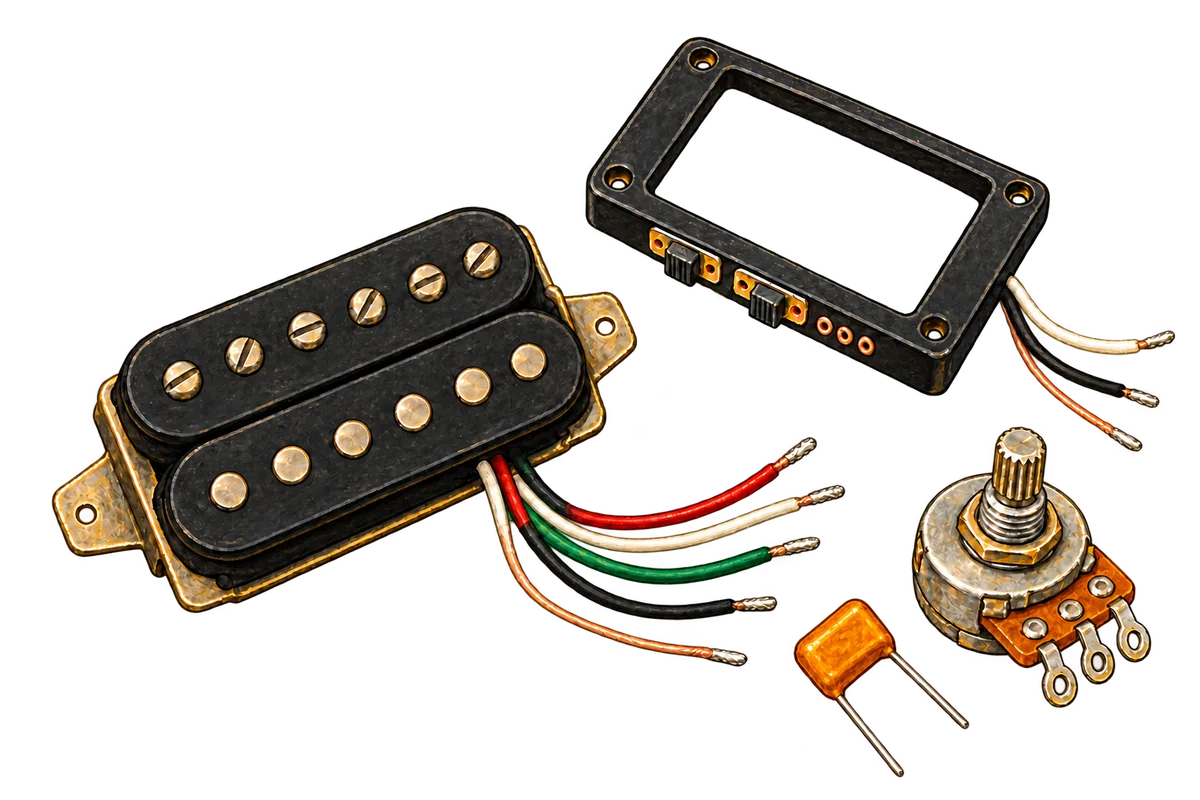
The blade’s second row is not wasted here. It feeds the two tone pots, which the sheet labels Neck Tone and Mid Tone. The volume and tones are 250k, and our drawing uses a CTS 250k Audio Pot and a DPDT Mini-Toggle. The example pickups in our drawing are the Tonerider Alnico 2 Classic humbucker and the City Limits Middle.
Our drawing is at revision 3. Its note says the Mid Tone was rewired so the knob is bright at 10 and darkest at 0; before that, the feed and the capacitor sat on the opposite end lugs and the tone ran backwards. If you wired from an earlier copy of our diagram, check that tone.
500k or 250k?
DiMarzio’s two HSH sheets use 500K custom taper pots throughout. Tonerider’s uses 250k. The makers do not agree, so take the value from the sheet for the pickups you are fitting. Our article on 250k vs 500k pots counts how the library’s HSS and HSH diagrams split between the two.
Before you solder
- Join each humbucker’s black and white only where the sheet sends them: to the blade on the DiMarzio sheets, to the mini-toggle on Tonerider’s. Do not tape them off, or the split will not work.
- Ground every green and bare lead and the middle pickup’s ground lead to the volume casing, as all three sheets do.
- Meter the full humbucker positions and the split positions before you close the guitar, as in the checks above.
Our guide on how to solder guitar wiring covers joints on pot casings, and why a guitar buzzes covers grounding problems. To push the split onto a knob instead of the blade, the Seymour Duncan coil split article walks through an HSH push/pull that splits both humbuckers.
More HSH layouts in the library
- HSH with rail middle, super switch, volume and tone (DiMarzio)
- HSH with stacked middle, super switch, volume and tone (DiMarzio)
- Steve Vai PIA HSH autosplit volume push-pull high-pass (DiMarzio)
Each opens in the workbench, where you can change the pots, capacitor or switching and save your own board. The full wiring diagram library lists every HSH layout we have drawn, and the controls and switching course covers pots and switches in more depth.
References
From the Tinkercaster library
- DiMarzio HSH five-way with volume and tone: leads, connections, position list.
- DiMarzio PAF Pro Green Meanie HSH with auto-split: HS-2 middle, bench checks.
- Tonerider HSH, five-way, volume, two tones, mini-toggle split: mini-toggle split, 250k pots, revision note.
Manufacturer sources
- DiMarzio: Humbucker/Standard Single/Humbucker (PDF): position list, reverse polarity middle, 500K custom taper pots, .022µF.
- DiMarzio: PAF Pro Green Meanie H/S/H with split coils (PDF): PAF Pro DP151 and HS-2 DP116, same position list.
- Tonerider: 2 Humbuckers + 1 Single Coil, DPDT mini-toggle split, from Tonerider’s wiring diagrams: 250k pots, shared .022µF.