 Tinkercaster
Wiring ideas
Seymour Duncan coil split on a Strat five-way switch
Four Seymour Duncan ways to split a humbucker on a Strat five-way blade: the position 2 auto-split, push/pull for HSS and HSH, and a two-humbucker blade split, with meter checks.
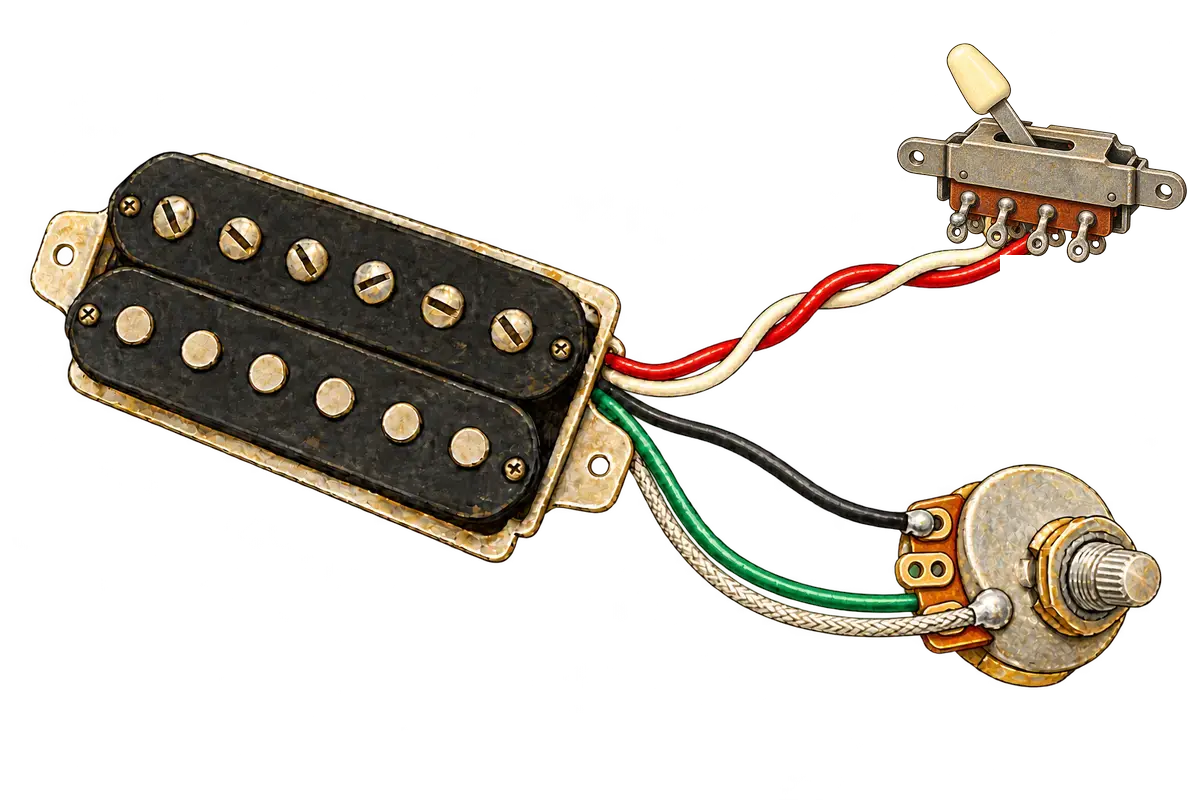
Put a humbucker in a Strat and the five-way blade becomes the obvious place to split it. Seymour Duncan publishes several ways to do that, and our library has drawn 23 of them for five-way switches, with more Tonerider HSS sheets beside them. They fall into two groups. In the first, the blade’s spare row does the splitting on its own, in a fixed position. In the second, a push/pull pot splits the humbucker whenever you pull the knob.
This article traces one of each in full, then two variations: one push/pull that splits two humbuckers, and a blade that splits two humbuckers with no extra switch. If you want the basics first (what a split is, why it adds hum, how it differs from a coil tap, and the colour codes for other brands), read our coil split wiring diagram guide. Here we stay on Seymour Duncan pickups and the five-way blade.
The four wires that matter
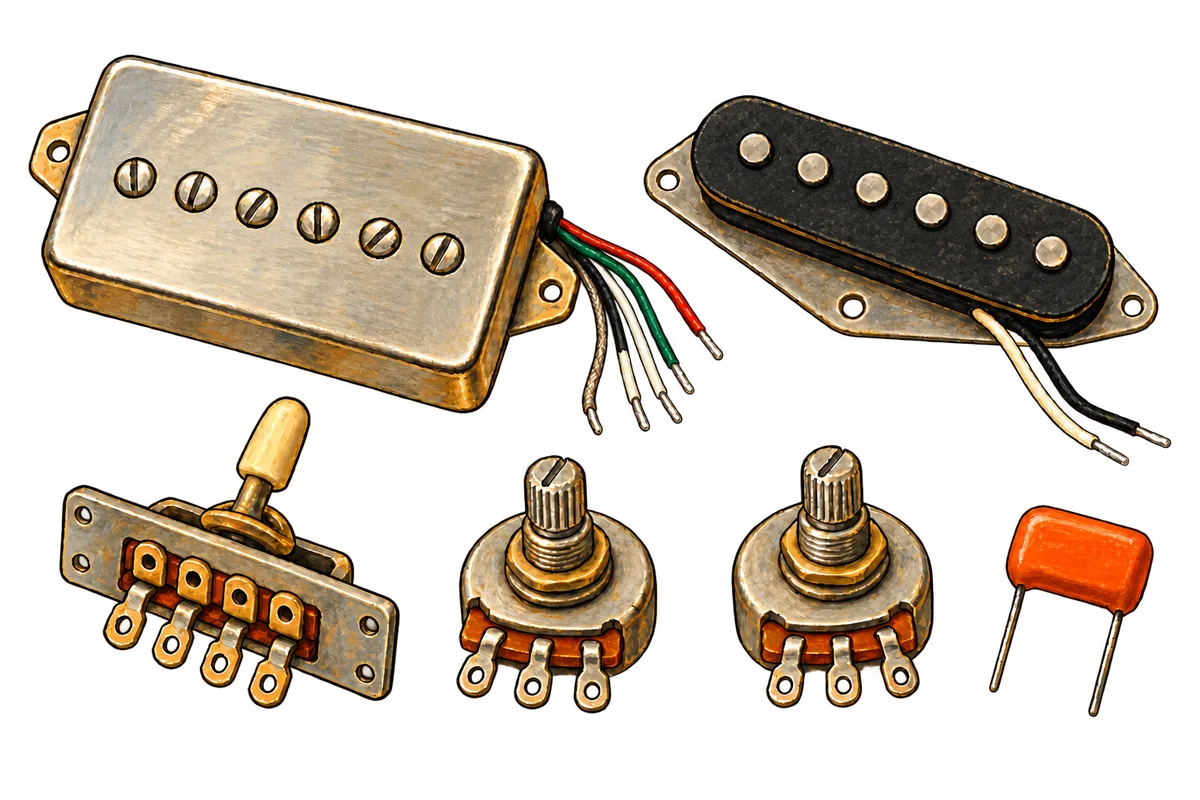
Seymour Duncan humbuckers have four conductors and a bare shield. Black is hot, green and bare go to ground, and red and white are soldered together: that joint is the series link between the two coils. Seymour Duncan’s humbucker internals article describes what happens when you ground the red and white joint: the screw coil goes silent and the slug coil carries on alone, with single-coil tone and output. Every split below is a different way of connecting that red and white joint to ground at the right moment.
Strat-sized humbuckers use the same code. Seymour Duncan’s guide to single-coil-sized humbuckers says all of them “come standard with 4-conductor lead wires”, and lists auto-split, push/pull and mini-toggle wiring as the usual options. The same guide says the Vintage Rails and the Duckbucker are meant for parallel wiring, so check your model before you plan a split. The Hot Rails Strat is a typical splittable one: four conductors, 10.9k for the neck and middle, 16.6k for the bridge.
Our Seymour Duncan wire colour guide shows the leads on a drawing of the pickup, and the coil splitting guide animates the split itself.
The auto-split: the blade does it in position 2
Seymour Duncan’s auto-split sheet for two single coils and a bridge humbucker gives the humbucker two sounds without an extra switch. Position 1 plays the full humbucker. Position 2 plays the middle pickup in parallel with one coil of the humbucker.
Seymour Duncan HSS, five-way auto-split, one volume and two tones sharing one .047 cap, drawn by Tinkercaster from sheet 2S_1H_5W_1V_2T_AS.
Parts, connections and bench checks ↗Open interactive diagram ↗The parts are a JB Model SH-4 in the bridge and two Vintage Staggered SSL-1 single coils as examples, an Oak Grigsby five-way blade, three pots and a .047 µF capacitor. The sheet prints no pot values, so the diagram uses 250k as a stand-in, the usual value for single coils.
How the second row splits it
A five-way blade has two rows of four lugs. Each row has a common, and a wiper that touches one contact in positions 1, 3 and 5 and two neighbouring contacts in positions 2 and 4. In a standard Strat the second row carries the tone controls (our Strat five-way switch article traces that layout lug by lug). This sheet moves both tones onto the first row, which frees the second row for the split.
On the second row the humbucker’s red and white sit on the lug that the wiper touches in positions 1 and 2. The next lug along, the one it touches in positions 2, 3 and 4, is wired to ground. The row’s common is left empty. In position 1 the wiper touches only the red and white lug, so nothing happens and the humbucker plays in full. In position 2 the wiper spans both lugs and joins the red and white to ground: the humbucker splits. From position 3 on, the wiper has left the red and white lug, and the humbucker is out of the circuit anyway.
An empty common feels wrong the first time you see it, but here it is correct: the wiper only has to join two of its own contacts, and nothing else on that row needs to reach the volume.
Every connection
The numbers match the connection list on the diagram page, which is in soldering order.
Grounds:
- (1, 2) Neck black and middle black to the volume casing.
- (3, 4) Humbucker green and bare to the volume casing.
- (5) Second row, third lug to the upper tone casing. This is the grounded lug that does the splitting.
- (6) The volume’s third lug bent onto its own casing.
- (7, 8, 10, 11) Volume casing to the jack sleeve and to the upper tone casing, upper tone casing to lower tone casing, and the bridge ground wire to the lower tone casing.
Pickups to the first row, counting from the top of the drawing:
- (14) Humbucker black to the top lug, the bridge contact.
- (13) Middle white to the second lug.
- (12) Neck white to the third lug.
The split and the signal path:
- (15, 16) Humbucker red and white together on the second row’s second lug.
- (17) First row bottom lug, the common, to the volume’s first lug.
- (20) Volume middle lug to the jack tip.
Tones:
- (18) First row neck lug to the upper (neck) tone’s middle lug.
- (19) First row middle lug to the lower (middle) tone.
- (9, 21) The .047 cap from the upper tone’s cap lug to its casing.
- (22) A short link from the upper tone’s cap lug to the lower tone’s middle lug, so both tones share the one cap.
What each position does
| Position | Plays | Tone control |
|---|---|---|
| 1 | Bridge humbucker, both coils | None |
| 2 | Bridge humbucker split, in parallel with the middle | Middle tone |
| 3 | Middle | Middle tone |
| 4 | Middle and neck in parallel | Both tones |
| 5 | Neck | Neck tone |
Because each tone hangs on a pickup’s own lug, it works only when that pickup is selected. The full humbucker in position 1 has no tone control, like the bridge pickup on a vintage Strat.
The diagram page marks this sheet as drawn for reference and not simulated by our wiring engine, so the table above is traced by hand from the switch contacts. It matches the sheet’s title and the position notes on the page.
Check it with a meter
Measure the humbucker before you fit it, with the red and white still joined and touching nothing. Black to green gives the full humbucker (call it Rh). Black to the red and white joint gives the coil that stays on when you split it (Rc). Measure the middle pickup across its two leads (Rm).
| Check | Expected |
|---|---|
| Resistance, red and white lug to ground, position 2 | Close to zero: the blade has grounded the link |
| Same, any other position | About Rh minus Rc, the other coil, because the link still reaches ground through the green lead |
| Resistance at the jack, volume full, position 1 | About Rh |
| Same, position 2 | Lower than either: Rm × Rc / (Rm + Rc) |
The volume pot sits across the output at DC, so every reading at the jack comes out a little lower than the pickup alone. If position 2 reads Rh in parallel with Rm instead, the ground on the second row is missing or on the wrong lug.
Tonerider’s version of the same idea, HSS auto-split mod, also splits in position 2 through the blade’s second row, with a .022 µF cap instead of .047. Seymour Duncan has a single-tone version too, for a Strat-sized humbucker in the bridge.
The push/pull split: your choice in positions 1 and 2
The auto-split decides for you. If you want the full humbucker and the split in both positions, put the split on a push/pull pot. Our HSS push/pull diagram is drawn from a Seymour Duncan sheet with a Strat-sized humbucker in the bridge (the example part is a Little ’59 SL59-1, with the JB Jr. and Hot Rails wired the same way), one push/pull volume, one master tone and a .047 cap.
Seymour Duncan, two single coils and a Strat-sized humbucker, five-way, push/pull split volume and one tone.
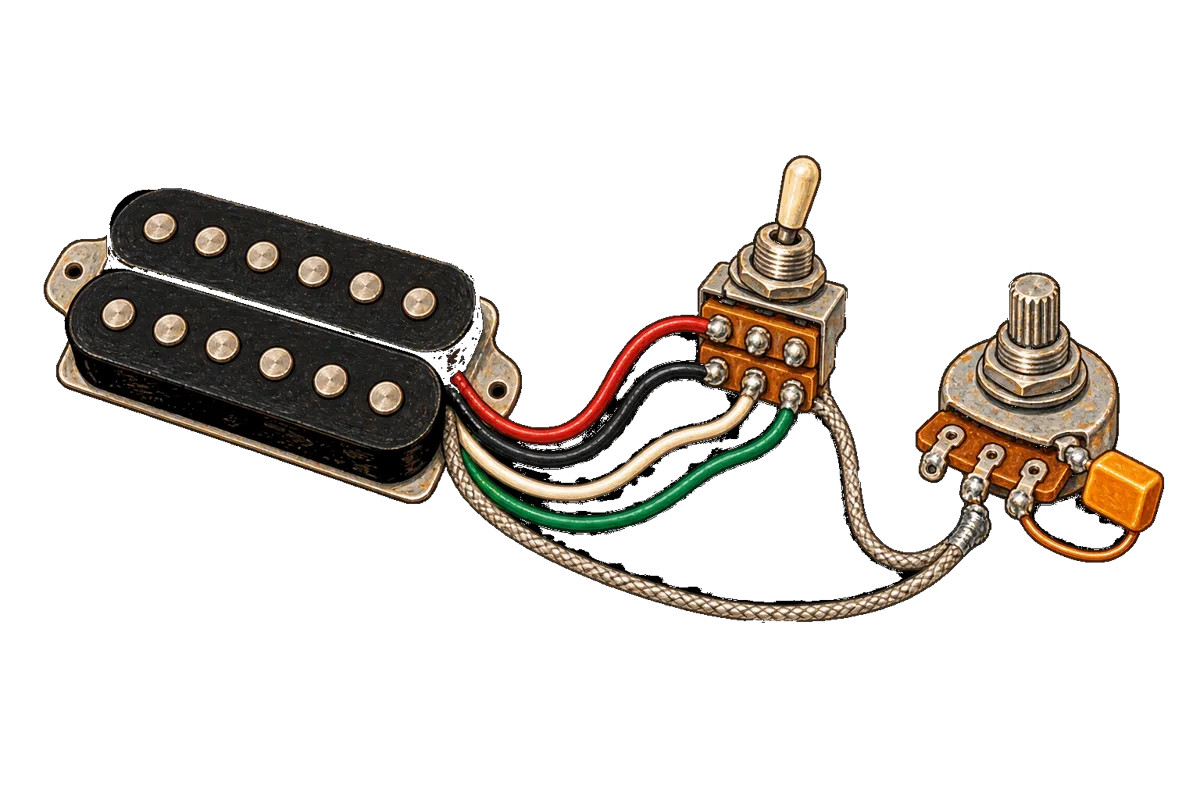
Parts, connections and bench checks ↗Open interactive diagram ↗The blade is wired like a master-tone Strat: the three hot leads on the first row, a jumper from its common to the second row’s common, and from there to the volume input. The split lives on the push/pull. The humbucker’s red and white go to the middle lug of one row of the push/pull (connections 16 and 17), and an outer lug of that row is wired to the volume casing (connection 1). Pull the knob and the middle lug joins that grounded lug: the humbucker splits. Push it down and the red and white float again.
| Position | Knob down | Knob up |
|---|---|---|
| 1 | Bridge humbucker | Bridge split |
| 2 | Bridge humbucker and middle | Bridge split and middle |
| 3 | Middle | Middle, no change |
| 4 | Middle and neck | Middle and neck, no change |
| 5 | Neck | Neck, no change |
Push/pull pots differ in which outer lug the middle lug joins when pulled. Before you solder, set the meter to continuity, put one probe on the middle lug, pull the knob and find the outer lug that beeps. That is the one to ground. Our catalog has a 250k push/pull for single-coil sets and a 500k push/pull if you prefer a brighter humbucker.
HSH: one knob splits both humbuckers
The Seymour Duncan HSH sheet uses one push/pull for two humbuckers. The neck and bridge humbuckers each put their red and white on the middle lug of their own push/pull row. The two outer lugs nearest the pot are jumpered together and grounded. Pull the knob and both links are grounded at once, so whichever humbucker the blade has selected plays split.
Seymour Duncan HSH, five-way, push/pull split volume and one tone, drawn by Tinkercaster from sheet HSH_5W_1VppSPL_1T.
Parts, connections and bench checks ↗Open interactive diagram ↗With the knob up, position 1 plays the bridge split on its own and position 2 the bridge split with the middle pickup. Position 5 plays the neck split on its own and position 4 the neck split with the middle. Position 3 is the middle single coil either way. The sheet prints a 250k (or 500k) push/pull volume, a 250k tone and a .047 cap.
The current sheet does not draw the neck humbucker’s green and bare leads, so we added them from Seymour Duncan’s 2006 original of the same sheet, which runs them to the volume casing with the bridge’s. The diagram page marks both connections as added. And the sheet prints a note: if the neck and middle pickups are Fender pickups, reverse the green and black wires on the Duncan. That is a phase fix, covered below.
Two humbuckers, split by the blade alone
The last sheet uses no extra switch at all. It has two humbuckers on a standard five-way blade, one 500k volume, one 500k tone and a .047 cap. In positions 4 and 5 the blade’s second row grounds the neck humbucker’s link, and the bridge humbucker is fed from its link instead of its black lead.
Seymour Duncan, two humbuckers, five-way blade with coil split, one volume and one tone.
Parts, connections and bench checks ↗Open interactive diagram ↗| Position | As drawn |
|---|---|
| 1 | Bridge humbucker |
| 2 | Neck and bridge humbuckers in parallel |
| 3 | Neck humbucker |
| 4 | Bridge split and neck split in parallel |
| 5 | Bridge split |
In positions 4 and 5 the bridge’s red and white reach the output while its black is disconnected, so the bridge plays the coil between the link and green. Read with the internals article above, that is the screw coil. In position 4 the neck’s link is grounded, so the neck plays the coil between its black and the link, the slug coil. We make no hum-cancelling claim for position 4.
The sheet’s printed legend calls position 4 “Bridge Humbucker plus Neck Split”. The drawing does not do that: the bridge black sits on a lug that is live only in positions 1 and 2. Our diagram follows the drawing, which is a working circuit, and the page explains the difference. If you build from the paper sheet, expect our table, not the legend. A two-tone version of the same switching is also in the library.
Mixing Seymour Duncan with other pickups
Positions 2 and 4 put two pickups in parallel, so their phase matters. Seymour Duncan’s polarity and phase article warns that “One manufacturer’s idea of a standard single coil might be another’s idea of a RWRP”, and that an out-of-phase pair sounds thin or hollow. Its fix is to swap the lead wires on one of the two pickups, not both. On a Seymour Duncan humbucker that means swapping black and green, which is exactly what the HSH sheet’s note asks for when the other pickups are Fender. Our single-coil phase reversal guide walks through the swap.
Mistakes first-timers make
- The red and white end up on two different lugs. They must stay soldered to each other. Separate them and the two coils are no longer joined, so the humbucker goes silent.
- Grounding the wrong pair. Mix up the leads and the split either kills the pickup or does nothing. Meter each lead against the colour code before you cut anything.
- Wiring the second row like a standard Strat. On the auto-split sheet the second row carries the split, not the tones. If you copy tone wires there from a Strat diagram, position 2 will not split.
- Grounding the wrong push/pull lug. Pulled and pushed contacts differ between makes, so find the pulled contact with the meter first.
- A loose shield. The bare wire is ground. If it brushes a hot lug the pickup goes silent. Our buzzing guide covers what to check when a split adds more hum than you expected.
Tin each wire before it goes on a lug and keep the solder small: the blade’s lugs sit close together. Our soldering cheat sheet shows a good joint, and the multimeter course covers the continuity and resistance checks above.
Build it
Open any of these diagrams and check its connection list against your pickups, switch and pots. Or start a blank board with the parts you actually have and wire the split yourself: the same checks run on both, and they flag a wrong lug before you heat the iron. The diagrams, catalog and courses are free, and you can open a diagram in the workbench, save it and change it, for example to move the auto-split to a different position. With Tinkercaster Pro you can ask Luthier about a connection and follow a guided build with meter checks at every step.
References
From the Tinkercaster library
- HSS five-way auto-split, volume and two tones (Seymour Duncan): traced in full above.
- Two singles and a Strat-sized humbucker, five-way, push/pull split (Seymour Duncan): split on the volume’s push/pull.
- HSH five-way, push/pull split (Seymour Duncan): one knob splits both humbuckers.
- Two humbuckers, five-way blade split (Seymour Duncan): split by the blade alone, with the legend difference in position 4.
- HSS auto-split mod (Tonerider): the same position 2 split with a .022 µF cap.
- Guides: coil split wiring diagram, Seymour Duncan wire colours, coil splitting explained, single-coil phase reversal.
- Catalog: JB Model SH-4, Vintage Staggered SSL-1, Hot Rails bridge, Oak Grigsby 5-Way, CTS 250k push/pull, CTS 500k push/pull, Orange Drop .047µF.
Manufacturer sources
- Seymour Duncan: guitar wiring explored, humbucker internals: grounding the red and white silences the screw coil and leaves the slug coil.
- Seymour Duncan: guide to single-coil-sized humbuckers for Strat: four-conductor leads as standard, auto-split, push/pull and mini-toggle options, Vintage Rails and Duckbucker meant for parallel wiring.
- Seymour Duncan: Hot Rails Strat: four-conductor lead, 10.9k neck and middle, 16.6k bridge.
- Seymour Duncan: pickup polarity and phase made simple: mixing brands, and swapping the leads on one pickup only.